Does The Enterprise 2.0 Emperor Have No Clothes?

It’s noon, the keynotes have been going on all morning, and I have only just been inspired to blog. I’m not saying that standalone Enterprise 2.0 initiatives have jumped the shark, but there’s only so much rah-rah about enterprise collaboration that I can take before I fall back on three thoughts:

  1. Collaboration is already going on in enterprises, and always has: all that Enterprise 2.0 does is give us some nicer tools for doing what we’ve already been doing via word of mouth, email, and other methods.
  2. Collaboration is just not that interesting if it doesn’t directly impact the core business processes.
  3. The millennials are not going to save us.

People collaborate inside enterprises when they care about what they do. In other words, if you make someone’s job interesting and something that they have passion about, they will naturally collaborate using whatever tools are at hand in order to do it better. Andy McAfee’s keynote included a point about Enterprise 2.0 cargo cults, where organizations believe that deploying some tools will make the magic happen, without understanding all of the underlying things that need to be in place in order to make benefits happen: I strongly believe that you first have to make people care about their work before they will engage in creative collaboration, regardless of the shiny tools that you give them.

That brings me to the second point, that this has to be about the core business, or it’s just not very interesting at the end of the day. It’s not about providing a platform for some fun Facebook-for-the-enterprise; it’s about providing tools that people need in order to do their job better. In the 90’s, I was often involved in projects where people were using Windows for the first time in order to use the systems that we were creating for them. Some companies thought that the best way to train people on Windows was to have them play Solitaire (seriously); I always found it much more effective to train them on Windows using tools that were applicable to their job so that they could make that connection. We risk the same thing today by teaching people about enterprise social software by performing tasks that are, ultimately, meaningless: not only is there no benefit to the enterprise, but people know that what they’re doing is useless beyond a small amount of UI learning. I’m not saying that all non-core enterprise social functionality is useless: building an enterprise social network is important, but it’s ultimately important for purposes that benefit the enterprise, such as connecting people who might collaborate together on projects.

The millennial argument is, not to put too fine a point on it, bullshit, and I’m tired of hearing it spouted from the stage at conferences. You don’t have to be under 28 to know how to live and breathe social media, or to expect that you should be able to use better-quality consumer tools rather than what a company issues to you, or to find it natural to collaborate online. Many of us who are well north of that age manage it just fine, and I don’t believe that I’m an outlier based on age: I see a large number of under-28’ers who don’t do any of these things, and lots of old fogies like me who do them all the time. It’s more about your attitudes towards contribution and autonomy: I like to give back to the community, I’m an independent thinker, and I work for myself. All of these drive me to contribute widely in social media: here on my business blog (occasionally cross-posted to Intelligent Enterprise and Enterprise Irregulars), my personal blog, on Twitter, on Flickr, on Facebook, on YouTube, on FourSquare… wherever I can either connect with people who I want to be connected with, or where it amuses me to broadcast my thoughts and creations. For those of you who don’t do any of this, wake up! Social networking is your personal brand. You just need to accept that as truth, and take advantage of it. The ones who don’t, and use their age as an excuse for it, just don’t get it, and you shouldn’t be listening to anything that they say about social media.

To wrap it up: enterprise collaboration is good when it has a business purpose, and anyone can do it.
One Last Conference Before Summer: Enterprise 2.0

It’s been quiet on the travel scene since my four-week marathon of conferences in May, and I have just one last one before we hit the summer doldrums: Enterprise 2.0 in Boston this week.

I’m skipping the workshops today and heading down this afternoon – luckily, Toronto-Boston is covered by Porter Airlines, so I can fly without enduring the hassle of Toronto’s bigger airport – and will be there until Thursday midday. I’ll be live blogging as usual, and tweeting using the #e2conf hashtag.

Although standalone collaboration tools can show significant benefits, my interest is in how social features are becoming part of enterprise software, especially BPM and ECM. Consider, for example, tomorrow morning’s keynote at 10:50am (for a too-short 20 minutes) by Franz Aman of SAP:

Standalone collaboration environments and social networks have been the focal point in the market to date, but what is possible when you marry traditional enterprise software with newer enterprise 2.0 thinking? To start, you free people from the struggle to use enterprise systems and you help them find the right information for daily work. You put into their hands powerful, business-relevant content-including business processes, data, events and analytics -that combines structured data and unstructured data from social and online networks to bring together people, information and business methods in a cohesive online working environment.

I’m disappointed that more of the BPM vendors aren’t here to discuss how social features are changing their platforms; not sure that this conference is on their radar yet.

Recording of Using Wikis With ECM and BPM

If you were interested in the presentation that I did last week at Toronto Wiki Tuesday on using wikis with enterprise content management and process management, here’s an audio recording of it made by Robert Lavigne. There’s a fair amount of background noise from the projector fan and the clinking of beer glasses, but it’s pretty audible.

BPM Summer Camp: Business Users and BPMN

I presented today on the second part of Active Endpoints’ BPM Summer Camp, discussing just how much BPMN your business users and analysts need to know. Michael Rowley, CTO of Active Endpoints, gave a demo of BPMN using their system, including illustrating a number of the concepts that I introduced in my presentation.

You can view and download my slides here:

A few other references based on the questions at the end of the presentation:

We have the third and last part of BPM Summer Camp, “Five Things You Should Never, Ever Try in Process Development”, on July 22nd; head over to the landing page to sign up for that, as well as see a replay of the first two parts.

BPM Summer Camp Again This Week: Explaining BPMN to Business Users

I’m presenting part 2 of BPM Summer Camp tomorrow, June 9 at noon ET, on How to Explain BPMN to Business Users. I’ll be joined by Michael Rowley, CTO of the series sponsor, Active Endpoints.

In this edition, we’ll be looking at BPMN as a standard, and what parts of it are really necessary for business users and business analysts. There’s been a lot of controversy lately over whether business users and analysts can – and should – learn enough BPMN to make it useful to them, or if there should just be some other process modeling paradigm for non-technical people; tomorrow, I’ll look at just how much BPMN they would have to learn in order to make it work.

As usual, this will be presented live, and we’ll keep going until all of your questions have been answered. Sign up at the link above, and see you tomorrow!

Wikis With ECM and BPM

Here are the slides from the presentation that I did last night at Toronto Wiki Tuesday:

It was recorded on Ustream, but the quality was not very good since we were in a pub, not a studio. There will be a better-quality audio recording available soon. And, although we do Wiki Wednesdays on Tuesdays here in Toronto, there were some tweets on the WikiWed hashtag.

I’ve been looking at the crossover between wikis and ECM for a while, and I’ve more recently been looking at where BPM and wikis intersect: still a small area, but as BPMS get more collaborative and wikis add some structured workflow, there is definitely an overlap.

Toronto Wiki Tuesday: Using Wikis with Enterprise Content and Process Management

I’m presenting at Toronto Wiki Tuesday tonight on the interaction between wikis, ECM and BPM.

The organizers might be setting up to broadcast this live on Ustream; if so, I’ll update this post later today with the URL of the video stream.

Update: the presentation will be streamed live here at 7pm ET tonight.

Pegasystems SmartBPM V6

I’m wrapping up my coverage of this month’s round of four back-to-back conferences with the product reviews, which typically come from multiple meetings before, during and after a vendor conference, as well as some time spent pondering my notes and screen snapshots.

I had a remote product demo of SmartBPM prior to PegaWORLD, then a briefing from Kerim Akgonul at the conference. A lot of the changes to the product over the past year and a half have been focused on making it easier to use, trying to fight the perception that it’s a great product but that the inherent complexity makes it hard to use. In fact, the two main themes that I saw for this version are that it’s easy to use, and easy to share through design and runtime collaboration.

They started to address the complexity issue and promote the business agility message in Version 5 more than a year ago with a number of new tools:

  • Application Profiler to link requirements directly to developed applications and processes, replacing written specifications; the Application Accelerator then generates an application from this profile, as well as documentation
  • Improved non-technical process mapping with a shared model between business analysts and developers, including having the BA create UI forms
  • Visual Case Manager for mapping data from other systems into a case management application via various shared keys and search terms
  • Internet Application Composer for creating mashups with their own portlets and web components, plus other internal or external web components

Version 6 continues this direction, focusing on deploying solutions faster: a number of new gadgets allow building out the user experience and providing better visibility into what’s happening within business processes, and direct feedback on changes required to processes from participants to developers/analysts puts more ability to change processes into the hands of the business.

They’ve also started to use their own agile-like methodology and tools for internal projects, since the tools provide frameworks for project management, test management and documentation. Not only has this resulted in more rapid development of their own products and better alignment with the product requirements, it has eliminated the monolithic product release cycle in favor of smaller incremental releases that deliver new functionality sooner: they’ve released Pega Chat and other new features as modules without doing a full product release. With 1,200 Pega employees and 200 new ones from their Chordiant acquisition, introducing ways to shorten their product release cycle is an encouraging sign that they’re not letting their increasing size weigh them down in product innovation.

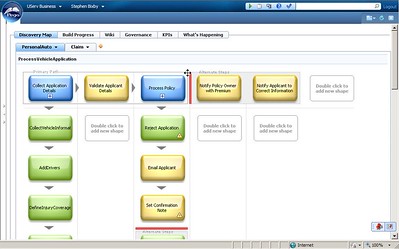
Discovery map viewTaking a look at the product, there’s a new Discovery Map view of a process, very similar to what you would see in the outline view other process discovery tools. The difference from other tools, however, is that this is a directly executable process: a shared model, rather than requiring a transfer to an execution environment (and the problems that come along with round-tripping). That ties in neatly with the “easy to use” theme, along with role-based views, reduced navigation complexity and case manager functionality.

The other theme, “easy to share” comes out in a number of ways. First of all, there’s a Facebook-style news feed of system-generated and team member alerts that shows who’s working with which processes and comments that participants have on them, including RSS feeds of the news feed and other sharing options to make it easy for people to consume that information in the format and tool that they choose; I’ve seen this in ARISalign and I suspect it will become standard functionality in most process discovery and design tools. With some of the sharing and bookmarking options, I don’t think that Pega even knows how (or if) customers are going to use them, but realizes that if you have to offer the functionality in order to start seeing the emergent usages.

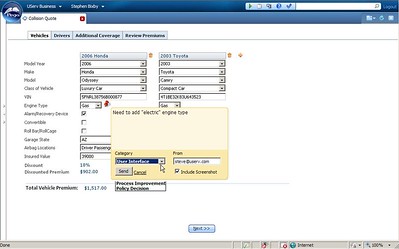
User adds change request to designerThe second collaboration win is direct feedback from the participant of an executing process to the process designer. This is the type of functionality that I commented on a couple of months ago when Google came out with a way to provide feedback direction on their services from within the service (my tweet at the time was please, please, please can enterprise apps add a feature like this?). In SmartBPM, a user within an executing process drags a pushpin icon to the location of the problem on the screen, types a note in a popup and adds a category; when they click “Send” on the note, the current state (including a screenshot) is captured, and an item is added to the process designer’s feedback list in their news feed. Hot.

We also reviewed process optimization: optimization criteria are selected from the process attributes, and calculated based on actual process execution. A decision tree/table can be directly generated from the optimization results and added as a rule to the process: effectively, this automates the discovery of business rules for currently manual steps such as assignment, allowing for more process automation.

User builds custom subprocess in discovery map viewThe third collaboration-type functionality shown was the ability to spin off ad hoc subprocesses from any point in a structured process: just select “Build a Custom Process” from the action menu on a step to open up a new discovery map for creating the new subprocess, then add steps to create the flow. There’s only an outline view, not flow logic, and the step names are people to which the step is assigned: pretty simple, but little or no training required in order to use it for everyday users.

Later, all custom subprocesses created for a given process can be consolidated and summarized into suggested changes, and directed to a process designer for review; this may result in the original structured process being reworked to include some of the common patterns, or just have them left as ad hoc if they are not frequent enough to justify the changes.

Akgonul sees BPM and CRM converging; that’s certainly the direction that Pega has been taking recently, including (but not limited to) the Chordiant acquisition, and similar opinions are popping up elsewhere. As BPM products continue to turn into application development suites meant for building full enterprise applications, the boundaries start to blur.

One thing that I liked about the remote demo that has nothing to do with the product is that it was hosted on an Amazon EC2 instance: it’s only a short step from an EC2-based demo to providing a preloaded EC2 instance for those of us who like to get our hands on the products but don’t want to handle our own installation. For technical analysts like me, that’s a game-changer for doing product reviews.

Pegasystems SmartBPM V6 - 2010 

As a matter of disclosure, Pega paid my travel expenses to attend their conference, and they are a client of mine for creating webinars, but I am not compensated for writing about them here on my blog.

Will Social Revive Interest In BPM? Will BPM Make Social Relevant?

Social BPM saw a flurry of activity last week in the BPM blogosphere for some reason; I’ve been writing and presenting on social BPM for about four years now, so most of this isn’t new to me, but it’s good to see the ideas starting to permeate.

Keith Swenson writes on who is socializing in social BPM, and how the major analysts’ view of social BPM is that the BPM application developers are socializing, not the end users; that misses the point, in Keith’s (and my) opinion, since it ignores the runtime social/collaborative aspects as well as the blurring of the boundary between designing and participating in processes. He writes:

The proper use of social software in the business will eliminate the need for process designers.  Everyone will be a designer, in the way that everyone is a writer in the blogosphere.

This last part is not strictly true: everyone could be a writer in the blogosphere, but in reality, only a tiny fraction of those who read blogs actually write blogs, or even comment on blogs. The same will likely occur in runtime collaboration in BPM: only a fraction of users will design processes, even though all have the capability to do so, but all will benefit from it.

Then, at SAPPHIRE this week, I had a conversation with Enterprise 2.0 adoption expert Susan Scrupski, founder of the 2.0 Adoption Council, about her characterization of SAPPHIRE as 2.0 Reality Rehab, and her distressing discovery that 0 out of 20 SAP customers who she interviewed on the show floor had ever heard of Enterprise 2.0.

Distressing to her, but not so surprising to me: enterprise social software is not exactly mainstream with a lot of large companies that I work with, where wikis are used only by IT for tracking projects but not permitted into the user base at large, and blogs are viewed as disreputable sources of information. Imagine the reception that I get when I start talking to these companies about social BPM concepts: they don’t exactly warm up to the idea that users should design their own processes.

Before you jump all over me with examples of successful Enterprise 2.0 and social BPM adoption stories, I’m talking about mainstream adoption, not just in the echo chamber of those of us who think that this stuff is great, and root out the case studies like the rare and valuable gems that they are.

As a champion for Enterprise 2.0, and with only a few short weeks to go before the Enterprise 2.0 conference, Susan is keen to see more meaningful adoption within enterprises: not just more, but in applications that really make a difference for the core business of the company. This is, I believe, where social BPM can help: it’s an application that lends itself particularly well to collaboration and other social aspects, while providing a core critical function within enterprises. I’d love to see Enterprise 2.0 software vendors start to tackle core enterprise software, such as BPM, CRM and ERP, and stop building more enterprise wiki and blogging platforms. Think of it as 2.0 Reality Rehab for the whole Enterprise 2.0 industry.