Bad Processes? Great Service Makes Up For A Lot

Every process blogger loves to write about their own good and bad process experiences, and I’m no exception. This weekend has been a case of incredibly bad processes, but really good customer service that made up for it. I’m stuck in Frankfurt on my way back to Toronto, and I’m actually not unhappy at all, due to the outstanding service that I’ve received all along the way. The short version: my flight out of Oslo was delayed, which caused me to miss my connection in Frankfurt to travel on to Toronto.

Here’s how the process was seriously broken:

  • An SAS flight from Oslo to Frankfurt was leaving 15 minutes after my originally scheduled Lufthansa flight, but I was not allowed to switch to that flight because the transfer time in Frankfurt would be below their threshold. As it turns out, if I had taken that flight, which left on time, I would have made my connection, which left 30 minutes late. Instead, I had to take my original flight, which left over 2 hours late, and missed my connection.
  • With no Lufthansa or Air Canada presence in Oslo, SAS (which is a partner airline) services their customers. When the SAS agents were working with Lufthansa on the phone to try and rebook me, Lufthansa claimed that they couldn’t access my ticket since it was booked on Air Canada. I called Air Canada in London, who said that any changes had to be done by Lufthansa since the first leg of the journey was on Lufthansa. SNAFU.
  • In Frankfurt, it took over 2 hours for the first/business/gold line to process the 6 people ahead of me (luckily I was not in the plebe line, which had 200+ people). When I got up to the agent, I could see how cumbersome her process was: although my flight had already been rebooked, she went through the options for an earlier flight (I would have only been waitlisted, so didn’t bother), had to reprint a new ticket, book me into the hotel, then manually write up hotel and taxi vouchers. Even worse, the taxi voucher was a 4-part carbonless form; she filled it out, then ripped off and discarded 2 of the parts. My time with her, even though I was on a direct flight that had already been rebooked so was presumably the simplest possible case, was more than 20 minutes. People with more complex routing requirements were taking 45-60 minutes each.

I’m pretty sure that SAS/Lufthansa/Air Canada knew that I wasn’t going to make my connection before I left Oslo; they should have just put me up there for the night and flown me out in the morning. It would have taken me about 10 minutes in Olso rather than the 2+ hours in Frankfurt to deal with the rebooking.

There were some successful process bits:

  • Someone, somewhere, rebooked me on today’s Air Canada flight when I missed yesterday’s flight, ensuring that I have a seat.
  • In cases like this, Lufthansa just puts everyone in a hotel with meal and taxi vouchers, without questions. I may have had slightly better privileges because of my gold airline status, but it appears that everyone was being housed for the night, at least.

What really made the difference for me, however, was the level of service that I received along the way from people who knew that they worked for companies with stupid processes and policies, and did whatever possible to make things better for me:

  • The SAS agent in the lounge in Oslo worked diligently on my behalf on the phone for over 30 minutes, and apologized when he couldn’t do more.
  • The Lufthansa agent in Frankfurt was cheerful, even though she had been dealing with irate customers for several hours, and told me how nice the hotel was that she was sending me to (she was right).
  • The Radisson Blu Frankfurt, in addition to being a lovely hotel, has excellent staff. In particular, when I slept in this morning and missed the breakfast for which Lufthansa had provided a voucher, Nawid at the front desk had a great solution: he ordered me room service breakfast to eat in lobby, even though I had already checked out, and covered it with the voucher. He even thanked me for being tolerant of their rules about using the voucher (it couldn’t be used for lunch, only breakfast), and cajoled me into a much more extravagant breakfast than I would have ordered – I won’t need to eat all the way to Toronto.

To top it off, I also met Graham, an Australian trying to get home, in the line at the airport; we ended up at the same hotel and had dinner and a really interesting chat together. The whole effect – except for the extra stressful hours spent in the airports – has been to have a good dinner, a long restful night and a great breakfast at a nice hotel in Frankfurt, for free. And since I only had carry-on luggage, I even had clean clothes to put on today. Of course, if I weren’t on my way home to a chore-free Saturday, I might not be so sanguine about all this.

Severe delays due to weather don’t happen that often, so I can understand that the processes around them might be a bit inefficient; however, some of these seemed excessively bad. Some things that could have been improved in the Frankfurt rebooking process:

  • Email or text customers to tell them when they have been rebooked on a later flight. If I had known that, I would have had much less stress during my long wait. This would also reduce the number of people in the line, and the number that have to be processed manually.
  • Email or text electronic vouchers or confirmations for the hotel, with an option to accept (and go straight to the hotel) or decline and wait for individual service. That’s harder to do for taxi vouchers, but I would have gladly paid my own taxi fare to avoid the 2+ hour wait in line.
  • Triage the line so that people who can still get out on a flight that day are handled first. Since it was 7pm by the time that I got into line, there were probably very few people in that situation, but they were a bit desperate. Their rebooking would take much less time with no hotel or taxi vouchers, and they would be on their way much more quickly if just pushed to the front of the line, without risking them being delayed overnight. Or, if my first point was implemented, they wouldn’t even be in the line since they’d be automatically rebooked for their next flight.
  • Implement a better hotel and taxi voucher system that doesn’t require the agent to write all the information by hand. Once she had booked me at the Radisson online, if the system had printed both the hotel voucher and the taxi vouchers directly, that would have saved 10-15 minutes – it was the single biggest amount of time that I spent with her.

Travel has become so competitive these days that airlines need to make the experience better for their customers. That’s not just the “happy path” experience, when everything goes right, but the exception paths as well. Broken processes will eventually lead to customer attrition, no matter how good your customer service.

Henk de Man of Cordys at Software 2010

Only one other presentation at the Software 2010 conference in Oslo today was in English, which likely would have attracted me anyway, but I especially wanted to see Henk de Man of Cordys speak about adaptive BPM and case management in the cloud, which provides a nice bookend to my talk at the start of the day.

I couldn’t believe that it’s been three years since I last looked at Cordys, and I was looking for a bit of an update. Cordys Process Factory (CPF) is now tightly integrated with Google Apps, and they have some examples of customers using Google Apps, CPF and on-premise applications with data and transaction exchange between the cloud-based and on-premise software in a “hybrid cloud” configuration.

His focus today, however, was on case management: a higher-level coordination of activities that can’t be shown in a single structured process, with many bits of content and process works towards a common goal, such as is defined by OMG. This is emerging as a type of process modeling, separate but adjacent to the type of structured process modeling that we see in BPMN. In case management, there is a case file that contains all the relevant content, but multiple ways to achieve the ultimate goal, which might be dependent on the contents of the case file, current conditions, and the decisions of the individual participants working on the case. Forrester just released a research note on dynamic case management, and some of the older document management and workflow solutions are being repositioned into this “new” area, but the successful players will be those that can bring quality analytics, collaboration and modern user experience to bear: areas where Cordys is making inroads.

This is a bit of old wine in new bottles, but new technologies are definitely breathing life back into case management; the challenge will be to differentiate true case management processes from potentially structured complex processes that someone is just too lazy to model. Expect to see much more of this in 2010.

Enterprise 2.0 Adoption Council

In my conversations with several people this week, I’ve mentioned the Enterprise 2.0 Adoption Council as a place to start for finding out information about companies that are actually implementing this stuff. The Enterprise 2.0 Adoption Council gathers together managers from large organizations who are spearheading these efforts inside their company. The site includes research that the Council is doing on its members, such as their “State of Enterprise 2.0 Adoption” report for Q4 2009. Susan Scrupski conceived the idea for the Council and pulled it all together. You can follow her on Twitter here and read her business blog here for lots of additional information on how Enterprise 2.0 is being used in large enterprises.

If you have an interest in this area, then lots of good information here. If you’re a large enterprise implementing – or even looking at – Enterprise 2.0, consider joining the Council.

BPM and Enterprise 2.0 at Software 2010 in Oslo

I’m at the Software 2010 conference held by the Norwegian Computing Society in Oslo this week, and gave the opening keynote on one of the tracks this morning: how Business Process Management is being impacted by social software and social networking:

I gave a similar talk last November at the Business Rules Forum, but I find this topic to be endlessly changing and endlessly fascinating. I’ve written two related papers on it recently, too: one for the Springer BPM Handbook, and one for the Cutter IT Journal (specifically on runtime collaboration in BPM).

I won’t be attending most of the other sessions because they’re in Norwegian, but may pop out this afternoon and visit the Edvard Munch works at the National Gallery. I spent a few days in London earlier this week, visiting the Victoria & Albert, Tate Modern and British Museums, so that would round out my week nicely.

Pimping Your Fish at DemoCamp Toronto 25

After we heard from Gurbaksh Chahal, the rest of DemoCamp proceeded as usual. We were in the Ted Rogers School of Management, part of Ryerson University, in a really great lecture hall space that seats a few hundred people; it seemed like most of the seats were filled that night.

First up was Albert Lai of Kontagent. Albert demoed at the first DemoCamp and has appeared at at least one other. He seems to get a bit of a pass from the organizers: this time, as with the last time that I saw him, he had no actual demo – which is typically a requirement – but a lot of slides talking about social games.

After that, it was mostly Facebook night at DemoCamp: four of the five demos that followed were Facebook applications.

Next up was Mark Zohar of Scenecaster, showing the My 3D Cards application on Facebook. It uses the 3D foundation that they’ve built for enterprise projects, and used it to to take Facebook content and other rich content (video, photos, external links) to create a 3D rich media greeting card, displayed in a 3D application running in the browser using a custom Flash viewer. The idea was to show an immersive, engaging presentation of content for a specific purpose. The second app that he showed was Causes, which creates 3D content posted to your Facebook wall related to charitable causes. For causes such as Red Cross and WWF, it shows an “I donated” card with your picture, links to video about the cause, and a link to the donation site. They’re also working on an app for virtual gifts, using animated 3D, supporting multimedia and user-triggered animation; in the future, they’ll be looking at branded virtual gifts, too. In addition to their own apps, they’re syndicating their apps to other developers for other vertical applications; the first of these being developed is a 3D yearbook. These will be premium offerings, directly monetized within Facebook. They have a team of 5-6 dedicated people, using AWS, EC2 and S3 cloud-based content, composited at the client.

The demo that gave me this post’s title was by Greg Thomson of Tall Tree Games, showing their Fish World Facebook app: you can buy, raise and feed fish in a tank. (The friend I was there with turned to me and said “hey, my son plays with that!”) The focus of the demo was on monetization, a key subject for Facebook app developers: in this case, tanks are monetized through a variety of purchases, including fish, themes (including seasonal and holiday themes), plants, music and food. It uses two currencies: Facebook internal “coins” and fishbucks, which are actual purchased currency, at 5 fishbucks per $1. They find that they need to release new content a couple of times per week in order to maximize consumption; this is often done by creating a need (e.g., tank gathers algae, friends can steal fish), then selling a solution (e.g., algae-eater, security fish). They’re using analytics for targeting specific audiences, and in spite of my friend’s comment about how her son (who is under 10) plays with this, Thomson said that their primary demographic (75%) is women 20-35 years old. Huh?

Greg Balajewicz of Realm of Empires was up next, showing their massively multiplayer online strategy game on Facebook: you start with a village, build it up, recruit troops and so on. Everyone in the game is an actual person, with the game ongoing 24×7, and you can collaborate with others to plan battles and other campaigns. They have about 80k monthly active people in the game, 20k active daily, and although the game is free, they monetize with premium features that save you time in the game (e.g., a larger map view), but don’t explicitly advance your position in the game. They also have a standalone app, currently not monetized although they might offer a premium feature like this within the game, that allows any player to get a world view of all villages. They’ve done this with a small team and the three founders, with most people working remotely from each other and communicating using Skype. The game is targeted at men aged 25+; it can be played effectively in as little as 15 minutes per day. About 60% of their current players are in the US, 30% in other western countries, and a significant southeast Asia population at 7%.

Oz Solomon of Social Gaming Studios showed us their two seasonal apps: My Year in Status, and My Year in Photos. My Year in Status allows you to capture your year through your status: select a style, add a caption, and it generates a (text) collage of your status updates from 2009; you can customize and publish it to your news feed. My Year in Photos picks 16 photos from your 2009  photos (you can choose others if desired), then generates a photo collage for your news feed and photo album. Unlike the other apps, which are looking for steadier, constant growth, the seasonal apps had to spring into action for only a short period over the year end. They had 11M people use the app in a three-week period, with over 45 collages generated every second; it was the 3rd fastest-growing Facebook app for the week of Dec 21st after being covered by the mainstream media. About 80% of the users are women. They started work on the app on November 13th, launched it four weeks later, then had to do three server upgrades in a week to keep it up and running: they are using their own dedicated servers rather than cloud infrastructure. They found that seasonal apps are good for capturing viral streaks, but it’s best to build them on frameworks and code that you’ve developed for stable apps (such as their existing Status Shuffle app) in order to allow for fast development. Also, you can typically reuse these apps the following year, with some minimal-cost tweaking to keep them fresh. One interesting thing that he pointed out is that for the My Year in Status app, they fixed their #1 complaint, which was the lack of ability to choose which statuses were used, and found that although it reduced complaints by 80%, it only increased conversion rates by 2%: keep in mind that your most vocal detractors may not be that important to your bottom line.

Last up was Roy Pereira of ShinyAds.com, with the only non-Facebook app of the night. ShinyAds is a self-service advertising platform for web publishers that passes through more of the ad revenue to the publisher than other ad platforms such as Google AdSense. It’s not an ad network, but a tool for the web publishers to interact directly with advertisers. Advertisers can create their own advertising banner using a wizard-like interface: add or create a banner image, set the ad budget, set the click-through destination URL, set start and end dates, and target by geography. Once the ad is approved by the publisher, it’s inserted into the publisher’s ad server, or can use the ShinyAds ad server. Payments are made automatically to the publisher based on actual metrics, with the publisher interface includes a view of metrics and analytics.

All in all, a great DemoCamp, and the venue was excellent. I had stopped attending after a few disastrous nights in too-small venues (usually pubs) with crappy AV and wifi, but this has me back as a convert.

Gurbaksh Chahal at DemoCamp 25

DemoCamp Toronto #25 was held last week, with the usual array of demos and an extra special keynote: Gurbaksh Chahal, the highly-successful serial entrepreneur currently engaged in GWallet, an online payment system. Previously, he sold his first company at the age of 18 for $40M, then built BlueLithium to a point where it was acquired by Yahoo for $300M, and there were a lot of eager people in the audience to hear how they could get replicate that sort of success. Some of them were carrying along copies of his book, The Dream, hoping for an autograph.

He had a great set of points that I tried to capture; with each of these, he included examples from his own life that made them relevant:

  • The idea is only 1%, the rest is execution.
  • Don’t get too attached to your ideas. Sometimes that idea that you start a company with is just a starter idea, it’s not the one that you want to take to completion.
  • The biggest ($) deals happen when a company is bought rather than sold; that is, the buyer seeks out the relatively scarce resource and offers based on the perceived value of that scarcity, rather than the seller putting themselves up for sale.
  • Hire only rock stars, pay them well, and let them share in the ultimate rewards. Expect long hours, hard work and brilliance from them.
  • Never leave yourself vulnerable; consider everyone replaceable.
  • Don’t expect charity or favors, especially your first time around.
  • Never raise money when you need it: get traction first and wait for the money to come to you.
  • Bring in venture capital even if you have the means to self-fund, since that brings other ideas and governance.
  • In budgeting and spending, understand the difference between need and necessity. Money is finite, spend like every dollar is your last. People will only be impressed by your performance, don’t worry about the fancy trappings.
  • Every entrepreneur needs confidence (or the appearance of it). In any meeting, focus the conversation on the purpose of that moment.
  • Relationships are everything in life and the business world. Never burn a bridge. They’re not buying a product, they’re buying you.
  • There are only 5 key decisions that you need to make in order to make or break your company – make them wisely. His example at BlueLithium: hiring dream team, acquiring AdRevolver, raising 11.5M, opening up Europe a year after the US, selling to Yahoo at the right time for 300M although board didn’t want to sell. Knowing which are the key decisions requires instinct.
  • Surround yourself with people who want to see you successful and who are hungry. You don’t want to reward people who don’t contribute: you need people who will take a risk with you, and get rewarded for it.
  • Embrace rejection. Everything happens for a reason, it makes you stronger.
  • Make decisions, even if they may be wrong.
  • Always negotiate from a position of strength. Perception is reality: show people what they want to see, and tell them what they want to hear. Believe in yourself and sell the dream: no product or sales pitch is perfect.
  • Grow a thick skin. People will question your ability to succeed.
  • Do the work. Keep your eye on the tiger. Fight like Hell, defy the odds. It’s worth it. Never compromise your morals.

The gate receipts from that night’s DemoCamp, usually put towards some food or drink for the attendees, were donated to support efforts in Haiti following the earthquake. All of us put in $2,580; Gurbaksh, who had promised to match that, ended up tossing in another $10,000.

Lean Six Sigma and Process Improvement conference, Toronto

In a nice break from the past two years as a road warrior, I’ve only been on one trip since November. Even better, some conferences are coming to Toronto so that I don’t even need to travel (although not sure that February up here is a big draw if you don’t already live here).

This month, IQPC is hosting a Lean Six Sigma and process improvement conference on February 22-24 at the Westin Harbour Castle, with a focus on achieving a sustainable and transparent Lean Six Sigma and process improvement culture:

    • Increase Organizational Synergies by Applying LSS and Process Re-engineering to Consolidation and Organizational Restructuring
    • Maximize Benefits and Savings of Process Improvement Projects by Identifying and Implementing Low Cost Solutions
    • Bring the Quality of Your Products to a New Level of Efficiency by Applying Innovative Methodologies, such as Triz, to Your Transactional Processes and Engage Your Customers in Transactional Projects
    • Maximize the Efficiency of Internal and External Benchmarking by Expanding the Use of Dashboards

My readers can get 20% off the “All Access” price by using the code LSSCCol2 when you register here.

Disclosure: IQPC is providing me with a free pass to the show.

Another Call for Papers: Americas Conference on Information Systems

Although it’s very well-hidden on the information site, the 16th Americas Conference on Information Systems, to be held in Lima in August, will have a mini-track on BPM (it’s within the Systems Analysis and Design track):

This mini-track seeks contributions that discuss the management of business processes as well as technologies for process automation. We encourage submissions from both a
managerial as well as a technical perspective.

Suggested topics include, but are not limited to, the following:

-Business process automation and workflow management systems
-Business process and rule modeling, languages and design patterns
-Strategies for business process design and innovation
-Service-oriented architectures for BPM
-Resource management and capacity planning in BPM
-Information security and assurance in BPM
-Business process monitoring and controlling
-Process mining and its applications
-Business process governance, risk and compliance management
-Management of adaptive and flexible processes
-Management of ad-hoc and collaboration processes
-Management of knowledge-intensive processes
-Formal evaluation of BPM methods and technologies
-BPM adoption and critical success factors
-BPM maturity
-Standardization of BPM, web services and workflow technology
-Industry case studies on BPM technology or BPM applications

March 1st is the submission deadline for papers.

BPM 2010 Call for Papers: Research, Education and Industry


I’ve previously extolled the benefits of attending the annual international research conference on BPM, and for those of you in North America who just weren’t ready to shell out for a trip to Europe, you’re in luck: it’s coming to Stevens Institute in New Jersey in September. Although this has always been an academic research conference, rife with papers full of statistical analysis, this year the organizers are creating an industry track for practitioners to discuss the adoption and use of BPM:

The industry track will provide practitioners with the opportunity to present insight gained through BPM projects. We are particularly interested in case studies from the perspective of user organizations. While contributions from consultants and vendors are appreciated, pure product demonstrations, method tutorials, or vendor showcases will not be accepted in the industry track. All contributions to the industry track have to describe experiences with BPM methods and/or technologies from the viewpoint of the adopting organization.

This is not the usual conference PowerPoint deck: you have to actually write a paper. If you want to present in the industry track, you must submit an abstract by February 15th.

If you’re submitting a paper for the regular research tracks, the paper (not just an abstract) is due by March 14th. You can also submit a paper in the new education track, specifically about education and training methods for the BPM professional, also due by March 14th.

Even if you’re not giving a paper, I highly recommend that BPM vendors send along someone from their design/engineering team. This conference shows BPM research that (in some cases) indicates where product functionality could go in the future; best to get in there and see it first hand.

BPMN 2.0 Industry Update

It’s webinar day here at Column 2: this is my third in a row, this one an update on the BPMN 2.0 standard by Robert Shapiro, who participates in both the OMG BPMN 2.0 and WfMC XPDL 2.2 standards efforts. We’re already starting to see vendor support for BPMN 2.0, even though it’s not yet fully released, as well as books and training materials.

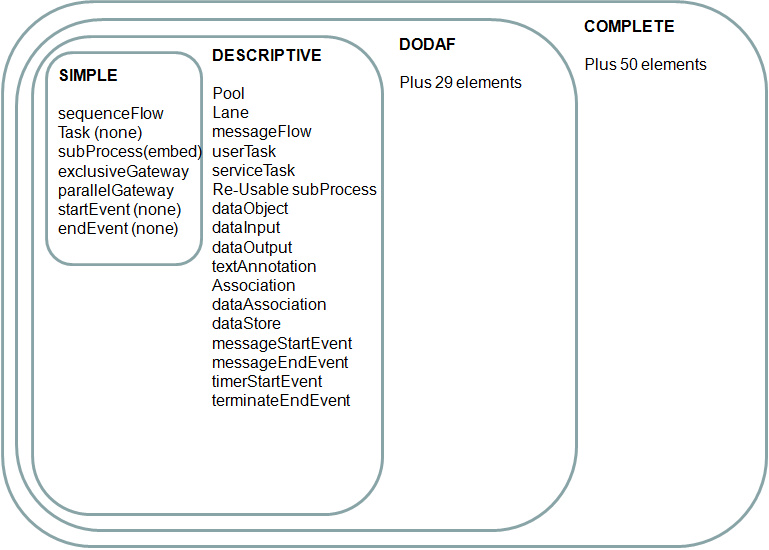
The concept of subclasses in process modeling has been included in this version, where there is a simple subset of eight elements used for process capture by non-technical process analysts/owners (start, end, sequence flow, task, subprocess, expanded subprocess, exclusive gateway, parallel gateway), then a larger subset for a “descriptive” persona, a larger-still subset for a “DODAF” persona, then the entire set of more than 100 elements.

You can download the accompanying PowerPoint deck for a more complete view of subclasses and their corresponding personas. I can certainly understand why many of the event variations were pushed out of the simple subclass, but I’m not sure that I agree with excluding pools and lanes, since these are pretty commonly used constructs. Also not sure why the US DoD’s enterprise architecture standard is impacting what is supposed to be an international standard.

These subclasses are important for vendors of modeling tools, but also for those looking to use BPMN as a standard for representing processes: this gives a good idea of how to split up the standard by the type of reader (persona) so that you don’t overwhelm the less technical audiences with too much detail, but also provide the greater levels of details for complete process specification.

Shapiro went on to discuss what most consider to be the most important (and likely the most controversial) part of BPMN 2.0: diagram interchange; BPMN 2.0 does not include an XSD schema, and there is ongoing work to create an XSD that is aligned with the metamodel. For those of you who follow BPM standards, you’ll know that XPDL is currently the de facto standard for process model interchange, supported by many vendors; these efforts are continuing in a separate organization (BPMN is managed by OMG, XPDL by WfMC) so it’s good that Shapiro and others are there to bridge the efforts across the two standards. We’re now seeing the emergence of XPDL 2.2, which will support the interchange of BPMN 2.0 process models. XPDL may eventually disappear in the face of a comprehensive BPMN 2.0 diagram interchange standard, but that will take years to happen, and a lot can happen in that time. In the meantime, XPDL will likely be used as an alternative diagram interchange format for BPMN 2.0 diagrams, with vendor support required for both standards.

The Business Process Incubator site has been created by several of the companies participating in both BPMN and XPDL standards efforts as a source for information as well as a variety of standard-related tools such as Visio templates. Shapiro also predicts that many tool vendors will release web-based BPMN 2.0 modelers, as well as BPMN and XPDL converters.

If you’re interested in where BPM standards are headed, it’s worth listening to the entire webinar, especially the Q&A at the end; I imagine that it will be available at the registration link on the WfMC site that I posted in the first paragraph.