Process Modeling With BPMN

I’m sitting in on Bruce Silver’s online BPMN course this week: this is the same as his onsite course, just using remote classroom tools to allow him to present and demonstrate to us, then get our feedback using typed chat. It’s a combination of lecture and hands-on, using a 60-day license for the business edition of the itp-commerce BPMN Visio add-in that is included with the course. The course runs 11am-3:30pm (Eastern) for three straight days, which took a bit of schedule juggling to be able to attend most of it; not sure if he is recording this for us to access after the course, which would be a nice benefit especially for those doing the certification exam. I use a lot of BPMN with my customers in my role as a process architect, but Bruce’s knowledge of the standard and its usage far outweigh mine, and I’m sure that I will learn a lot in addition to providing a review of the course for my readers.

He’s using the itp-commerce Visio tool, in spite of the hefty price tag ($975 for the Business Edition, $1,535 for the Professional Edition that also includes serialization; the free edition does not include full BPMN 2.0 support), because it natively supports Bruce’s methodology and style validation, which he covers in his book BPMN Method and Style and uses in this course. There are other Visio add-ons for BPMN 2.0 modeling, including one from Trisotech on the Business Process Incubator site that I’ve been using lately since it has a full-featured (but branded) version that customers can use for free, or the full non-branded version for the price of a BPI premium membership. Visio 2010 supports BPMN natively, but not the 2.0 version – if you’re a big Microsoft Visio customer, you might want to start agitating with Microsoft to include that via a service pack, since their current line seems to be that there isn’t sufficient demand for it yet. Bruce and I both believe that BPMN 2.0 support will become a significant differentiator for modeling products by the end of 2011, and Microsoft really needs to get on board with this if they’re going to be a player in the BPMN 2.0 market. There are some nice features in the itp-commerce tool that we didn’t cover in the course, such as simulation and BPMN 2.0 interchange, but many of those are available in lower-cost alternatives: I think that this is a race to the bottom price-wise, since Microsoft will eventually just include all of this in Visio natively.

He started with some basic definitions of BPMN and how it differs from flowcharts – especially in the area of collaboration, extra-process events and exception handling – highlighting the notions of standardization and of the hierarchical view that allows for inclusion of expandable subprocesses, rather than trying to put everything on one enormous top-level process model. He also covered how BPMN creates a bridge between business analysts who are creating these models, and developers who are making them executable, including the BPM systems that make the models directly executable without a lot of coding. He also discussed what’s not in the BPMN standard, such as user interface for human steps, data models, dynamic work assignments, rules, KPIs and anything to do with the higher-level strategy and goals. Although you may see some of these implemented in a BPMS, those will be done in a proprietary manner, and learning how to do that in that particular tool won’t be transferrable to other tools.

As I often do when I’m presenting a quick look at BPMN in a client presentation, he talked about the full BPMN 2.0 standard, with its new support for choreography and conversation diagrams, execution semantics and an XML schema for model interchange between tools, and highlighted that it’s possible to use the descriptive and analytic subclasses (subsets) of the standard if you don’t need to learn all 100 elements of the standard: the descriptive is for business analysts to be able to model processes as documentation, and the analytic is a minimum subset required to model executable processes.

Bruce keeps bringing it back to the value and benefits of BPMN: why it’s important both in terms of its modeling capabilities, and in the role as a standard for widespread understanding. There are a lot of BPMN detractors, but I don’t see the problem if you don’t try to shove the entire standard down the throats of business people: using the descriptive subclass (plus a few more elements), I’m able to have non-technical business people understand the notation in about 5 minutes, although it would take them a little bit longer to be able to create their own diagrams.

After an hour or so of initial presentation to provide the necessary background, Bruce shared his screen and had us all start up Visio with the itp-commerce add-in, and we started modeling some BPMN. As those of you familiar with BPMN know, there are only three main objects in a BPMN diagram: activities, gateways and events. The fun stuff comes with all the adornments that you can add to those three basic objects to indicate a huge variety of functionality.  We started off with a high-level straight-through order process, then added gateways for the exception paths. We started to learn some of the guidelines from Bruce’s style guide, such as using a gateway not to indicate work but only as a question testing the output state of the previous activity (which I always do), and using a separate end event for each distinct end state (which I rarely do but probably will start, since you can label the end events with the states). I also learned a standard Visio trick for moving the placement of the text on a connector using the Text Block tool, which allows you to snug labels of flows leaving a gateway right up to the gateway regardless of the connector length – cool! There were some great questions from the attendees, such as whether you can eliminate the gateway symbol and just have the labeled flows leaving the preceding activity, as you might in traditional flowcharting; in BPMN, that would denote have all of the paths be executed in parallel, not have one path or the other executed, so that’s not a legal representation of an exclusive OR gateway. Gateways can create a lot of confusion, because in spite of how they are often referred to as “decisions”, the decision is actually made in the previous activity, and the gateway just tests the result of that decision.

A great deal of day 1 alternated between some short presentations (a couple of slides each) on concepts, then exercises that allowed us to model those in diagrams ourselves, reinforcing the concepts immediately. While we were doing the modeling, Bruce would talk about other information about the concept, such as explaining some of the benefits and rules of pools while we were adding pools and lanes to our diagram, or the same for subprocess syntax. We saw some of the less-used but essential constructs such as ad hoc subprocesses, in which the contained activities don’t have a flow, and may be completed in any order (or not at all): this is how BPMN represents case management-style processes, for example, where the possible tasks are known but the order and applicability of any given task is not known. He also pointed out (and quizzed us on) common errors, such as having the same activity within a subprocesses and also in the process that calls it.

By the end of the first day, we had learned all of the Level 1 elements (effectively the BPMN 2.0 descriptive subclass), quite a bit of Bruce’s style guidelines around the use of those elements, and we were creating our own BPMN diagrams using those elements. At the start of day 2, after a recap, Bruce talked about having a BPMN method and style – whether it is his or not – so that there are standardized ways of using BPMN: in spite of it being a standard, it is possible to create diagrams that mean the same thing but look different, and having some standard usage makes it a more powerful communication tool within your organization. His method works toward four basic goals:

  • Structural consistency: a variety of the style points that he’s been covering, such as explicit end states and hierarchical composition
  • Readability: top-down traceability through levels of the process and subprocesses
  • Model completeness: diagram doesn’t require additional documentation to describe the process
  • Shareability with IT: models created by business analysts are aligned with the level 2 models used for executable processes

He then took us through the steps of his method for modeling processes that meets these goals; this was part of the essential intellectual property that he had to pass on to us (as opposed to the most standard BPMN on day 1), but too dense with slides and lecture rather than hands-on. Following that, he went through his BPMN style guides, which were also all lecture, but went much more quickly since these tended to be quick rules rather than larger concepts that we saw in the method section, and also we had covered a lot of these already in the exercises and the method. He did a blog post with a first cut of the rules and style of BPMN, both the standard BPMN rules and his style guidelines, plus a later post showing an example of reworking a process model to meet his style guidelines. The first is a great reference if you decide not to cough up for the itp-commerce product that will do the style validations for you; in reality, once you start using these for a while, they’ll become second nature and you won’t need to have them validated. He provided an updated list of the rules as part of the course, and has given me permission to republish, which I will do in a following post.

For the second half of day 2, we moved on to Level 2 BPMN elements (Analytic subclass) with more of the hands-on exercises on events: one of my favorite topics, since events are the most powerful yet the least understood of all BPMN elements. As Bruce pointed out, no one (not even him, and certainly not me) memorizes the table of 50 or so possible event permutations: for level 1 (descriptive subclass used by business analysts), you only need to know six of them (all start and end events), although I usually teach business analysts a couple of the intermediate events from level 2 as well. He suggests focusing on message, timer and error events, adding another nine to the six we’ve already seen; if you master these 15, then have to look up the others as required, you’re way ahead of most people using BPMN today.

Day 3 saw us still covering events via a combination of lecture and exercises; after timers on day 2, we moved on to message events and had a ton of great discussions on some of the finer points of BPMN usage (e.g., a script task that executes purely within the BPMS versus a service task that calls an external service). Message events are critical if you want to start modeling executable processes; intermediate message events are essential for automated messaging outside the process or organization, and boundary message events manage external events that modify or interrupt processes while in flight.  We also covered error events, and Bruce provided some supplementary information on other event types. Interestingly, Bruce is constantly reevaluating how BPMN can and should be used, with some changes over what he published in his book. He was a bit short on time for the last part of day 3 – the course timing definitely needs a bit of work – but we branched into splits and joins, went around iterations, and waded through multi-participant pools (which had an unfortunate effect on my brain).

He finished up with model validation using the itp-commerce add-in to Visio, which optionally validates against his style guide as well as the standard BPMN rules. As he puts it, any modeling tool that doesn’t provide validation against the BPMN specification is a toy, suitable only for drawing nice pictures. I suppose you could argue that after Bruce’s course, you will be able to validate automatically as you model so don’t need a tool to do it, but think of it as being like a spell-checker for process models: we all need a little help once in a while. 😉

He invited us all to go ahead and do the certification exam (no extra fee if done in the next 60 days), and showed one of the example multiple choice questions that had four possible answers, and received votes for all four of the answers from the class, showing that this is not quite as simple as it seems (yes, I got the right answer). If we pass that part, then we have to create a process model from one of our own processes of a specific level of complexity, following his method and style, and submit it for his review. Suffice it to say that certification via his BPMessentials exam will actually mean that you have mad BPMN skillz, it’s not just a certificate for showing up for the course.

Some potential improvements for the course:

  • It’s a bit hard to demo and talk at the same time, and Bruce could have captured screencams of some parts of the Visio demos to playback for us while he was discussing what we needed to do next, then just gone to Visio live for the finer points of demonstration; that would have made it easier for him to focus on describing what was happening rather than focusing on the actual drawing activity.
  • Some of the finer lecture points (such as going through the method and concepts) were a bit slow-moving, since Bruce would talk to one very dense slide for a number of minutes rather than having multiple slides with less information to absorb. Some restructuring of the slides would improve this, especially to show model snippets on the same page as the concept points, or possibly a much quicker summary to start, then return to the concepts later to reinforce.
  • The non-modeling exercises (e.g., defining the process scope given a specific scenario) didn’t work very well online, since there’s no fluid interaction with the participants, just the chat window with Bruce responding to the chat questions verbally when he sees them. In a regular classroom environment, he could ask for verbal solutions and write it out on a chart as they developed more collaboratively; here, all he could do was walk through the exercise and his solution. I’m not sure that a more interactive online collaboration tool would make a big dent in this problem; some things are just made for face-to-face (or at least audio) interaction. These sections could be enhanced by showing the process model solution at the same time as the exercise description – or better yet, a screencam – so that as he walks through it, he could point out how it manifests in the process.
  • It would be great to see a summary of the redundant elements in BPMN 2.0, with the preferred one (if one is preferred) indicated. For example, send/receive tasks are the same as intermediate throwing/catching message events except if you want to put boundary events (e.g., for error handling or timeouts) on the tasks in an executable process; a gateway is implied to be XOR if it has no marker; parallel split gateways and exclusive merge gateways are implied without showing the gateway. Although some of these are reflected in Bruce’s style guidelines, we just stumbled across some of them throughout the course.

I definitely learned some of the finer points of BPMN that I didn’t already know, and I will be going back to some BPMN diagrams that I’m working on with clients and clean up the style a bit with what I’ve learned. With this being an online course, I could multitask with other activities during the parts that were review for me; for a BPMN newbie (the target audience), the pace would have been just about right.

There are few people who have this depth of BPMN knowledge, and Bruce is the only one who I know who is doing this as a professional trainer: his is the only BPMN course that I recommend to my clients. He needs to work out a few bumps in how the online course works, but in general, I thought this was a great course, perfect for a business analyst who is already doing some process modeling but doesn’t know any BPMN, but also informative for those of us with some prior knowledge of BPMN.
IBM BPM: Merging the Paths

“Is there any point to which you would wish to draw my attention?” “To the curious incident of the dog in the night-time.” “The dog did nothing in the night-time.” “That was the curious incident,” remarked Sherlock Holmes.

Silver Blaze, Sir Arthur Conan Doyle

And so the fact of me (and others) not yet blogging about the IBM BPM release has itself become a point of discussion. 😉

To recount the history, I was briefed on the new IBM BPM strategy and product offerings a few weeks before the Impact conference, with a strict embargo until the first day of the conference when the announcements would be made. Then, the week before Impact, IBM updated their online product pages and the sharp-eyed Scott Francis noticed this and jumped to the obvious – and correct – conclusion: IBM was about to integrate their WebSphere BPM offerings. That prerelease of information certainly diffused the urgency about writing about the release at the moment of announcement, and gave many of us the chance to sit back and think about it a bit more. I only had a brief day and a half at Impact before making my way back east for another conference where I was giving a workshop, and here I am a week later finally finishing up my thoughts on IBM BPM.

There’s been some written about it already by others who were there: Clay Richardson and his now-infamous “fresh coat of paint” post, which I’m sure did not make him any friends in some IBM circles, Neil Ward-Dutton with his counterpoint to Clay’s opinion, some quick notes from Scott Francis in the context of his keynote blogging (which also links to the video of Phil Gilbert making the announcement), and Tony Baer as part of his post on a week of BPM announcements.

It’s important to look at how the IBM organization has realigned to allow for the new product release: Phil Gilbert, former president and CTO of Lombardi, now has overall responsibility for all of WebSphere BPM – including both the former Lombardi and WebSphere BPM products – plus ILOG rules management. Neil Ward-Dutton referred to this as the reverse takeover of IBM by Lombardi; when I had a chance for a 1:1 with Phil at Impact, I told him that we’d all bet that he would be gone from IBM after a year. He admitted that he originally thought so too, until they gave him the opportunity to do exactly what he knew needed to be done: bring together all of the IBM BPM offerings into a unified offering. This new product announcement is the beginning of that unification, but they still have a ways to go.

Let’s take a look at the product offering, then. They’ve take pretty much everything in the WebSphere BPM portfolio (Lombardi Edition, Dynamic Process Edition, Process Server, Integration Developer, Business Modeler, Business Compass, Business Fabric) and mostly rolled it into IBM  BPM or replaced its functionality with something similar; there are a few exceptions, such as Business Compass, that have just disappeared. This reduces the entire IBM BPM portfolio to the following:

  • IBM Business Process Manager (which I’m covering here)
  • IBM Case Manager (the rebranding of some specialized functionality built on the IBM FileNet BPM platform, which is separate from the above IBM BPM offering)
  • IBM Blueworks Live
  • IBM Business Monitor
  • IBM BPM Industry Packs

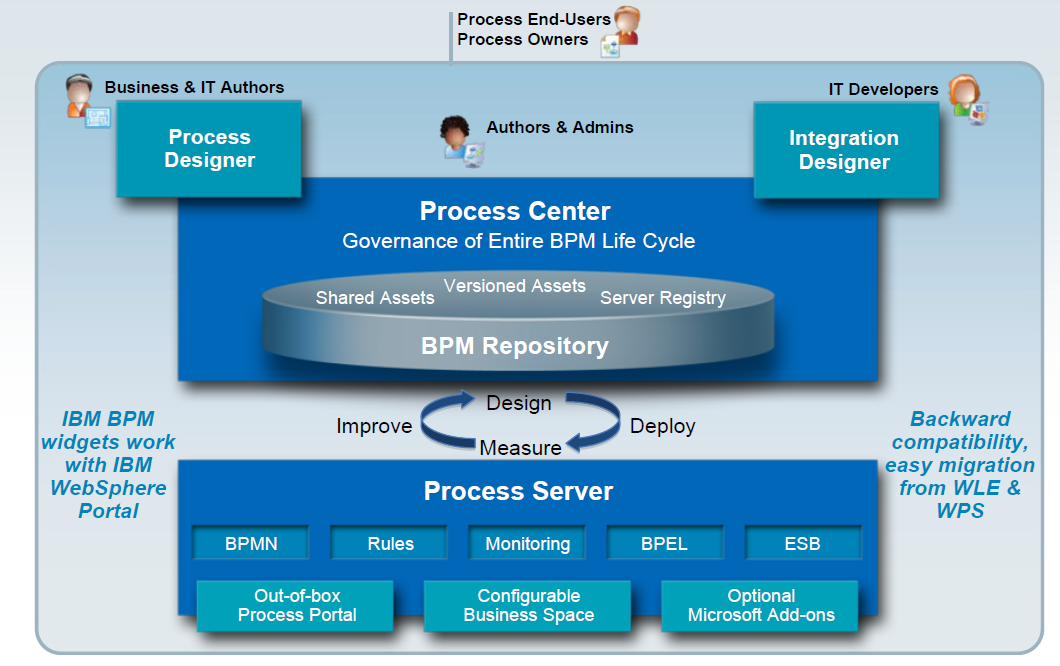
Combining most of the WebSphere BPM components into IBM BPM V7.5, the new product offering has both a BPMN Process Designer and a BPEL Integration Designer, a common repository, and a process server that includes both the BPMN and BPEL engines. Now you can see where Clay Richardson is coming from with the “new coat of paint” characterization: the issue of one versus two process “servers” seemed to occupy an inordinate amount of time in discussions with IBM representatives, who stoically recited the party line that it’s one server. For those of us who actually used to write code like this for a living, it’s clear that it’s two engines: one BPMN and one BPEL. However, from the customer/user standpoint, it’s wrapped into a single Process Server, so if IBM ever gets around to refactoring into a single engine, that could be made fairly transparent to their customers, but would likely have the benefit of reducing IBM’s internal engineering costs around maintaining one versus two engines. Personally, I believe that there is enough commonality between process design and service orchestration that both the designers and the engines could be combined into something that offers the full spectrum of functionality while reducing the underlying product complexity.

In addition to the core process functionality, the ILOG rules engine is also present, plus monitoring tools and user interface options with both the process portal and the Business Space composite application environment.

I don’t want to understate their achievements in this product offering: the (Lombardi-flavored) Process Center with its shared repository and process governance is significant, allowing users to reuse artifacts from the two different sides of the BPM house: you can add a BPEL process orchestration created in Integration Designer to your BPMN process created in Process Designer, or you can include a business object created in Process Designer as a data definition in your BPEL service orchestration in Integration Designer, or call a BPMN process for human task handling. The fact remains, however, that this is still a slightly uneasy combination of the two major BPM platforms, and it will likely take another version or two to work out the bumps.

Since this is IBM, they can’t just have one product configuration, but offer three:

  • The Express edition, offered at a price point that is probably less than your last car, is for starter BPM projects: full functionality of the Process Designer to build and run BPMN processes, but only one server with no clustering, so unlikely to be used for any mission-critical applications. If you’re just getting started and are doing human-centric BPM, then this is for you.
  • The Standard edition, which is pretty much the same human BPM and lightweight integration functionality as the former Lombardi Edition BPMS. Existing Lombardi Edition customers will be able to upgrade to this version seamlessly.
  • The Advanced edition, which adds the Integration Designer and its ability to create a SOA layer of BPEL service/process orchestrations that can then be called from the BPMN processes or run independently.

In the product architecture diagram above, the Advanced edition is the whole thing, whereas the Standard and Express editions are missing the Integration Designer; to complicate that further, current WebSphere Process Server/Integration Designer customers will be transitioned to the Advanced edition but with the Process Designer disabled, a fourth shadow configuration that will not be available for new customers but is offered only as an upgrade. Both engines are still there in all editions, but it appears that without both designers, you can’t actually design anything that will run in one of the engines. For current customers, IBM has published information on migrating your existing configuration to the new BPM; there is a license migration path for all customers who currently have BPM products, but for some coming from the traditional WebSphere products, the actual migration of their applications may be a bit rocky.

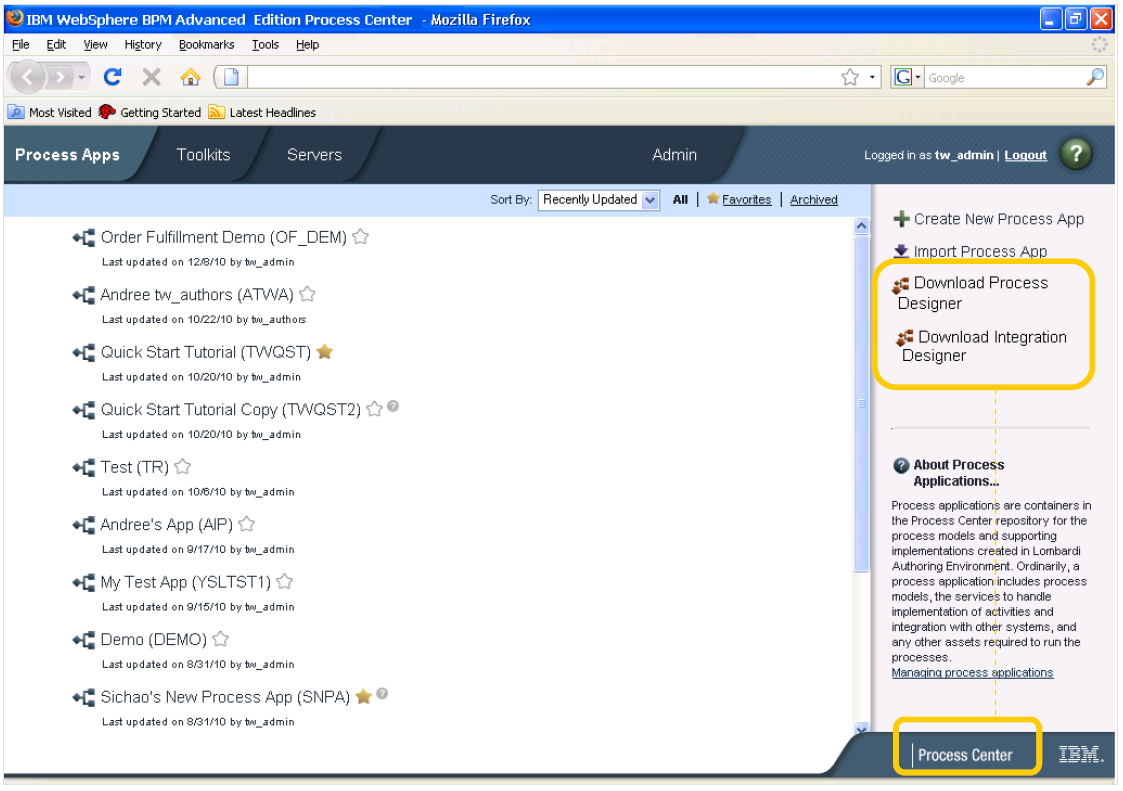
The web-based Process Center is used for managing, deploying and interacting with processes of both types, although the Process Designer and Integration Designer are still applications that must be downloaded and installed locally. Within the Process Designer, there’s the familiar Lombardi “iTunes-style” view of the assets and dependencies. It’s important to point out that the Toolkits are assets that could have originated in either the Process Designer or the Integration Designer; in other words, they could be human workflows running on the BPMN engine or service orchestrations running on the BPEL engine, and can just be dragged and dropped onto BPMN processes as activities. The development environment includes versioning, shared concurrent editing to view what assets that other developers are editing that might impact your project, playback of previous process versions, and all versions of processes viewable for deployment in Process Center. The Process Center view is identical from either design tool, providing an initial common view between these two environments. Linking these two environments through sharing of assets in the Process Center also eases deployment: everything that a process application depends upon, regardless of its origin, can be deployed as a single package.

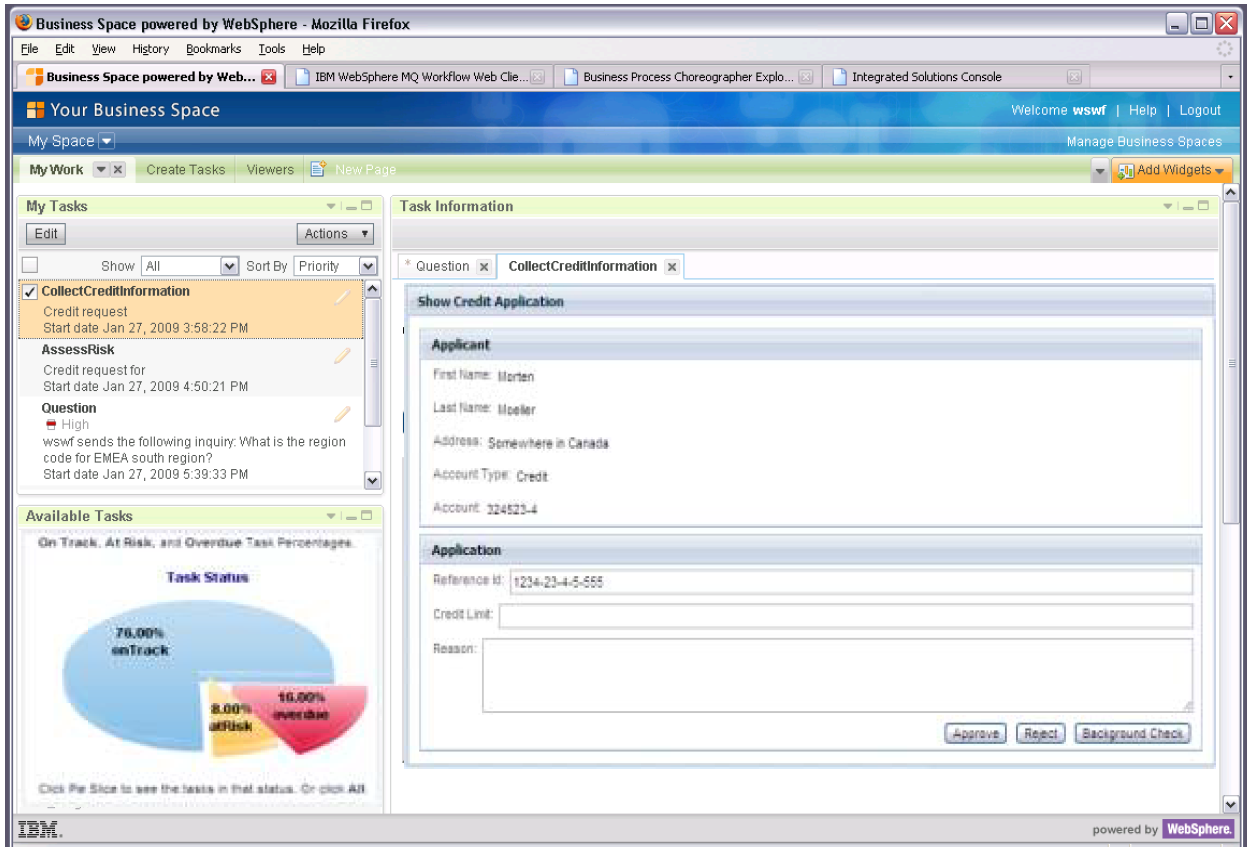
Not everything comes from the former Lombardi Edition, however: the user interface builder in BPM BPM is based on Business Space, IBM’s composite application development tool, instead of the old Lombardi forms and UI technology; this allows for easy reuse of widgets in portals, and there’s also a REST interface to roll your own UI. Also, the proprietary rules engine in Lombardi is being replaced with ILOG, with the rules editor built right in to the design environments; the ILOG engine is included in the Process Server, but can only be called from processes, not by external applications, so as to not cannibalize the standalone ILOG BRMS business. I’m sure that they will be supporting the old UI and rules for a while, but if you’re using those, you’re going to be encouraged to start migrating at some point.

There is currently no (announced) plan for IBM BPM process execution in the cloud (except for the simple user-created workflows in Blueworks Live), which I think will impact IBM BPM at some point: I understand that many of the large IBM customers are unlikely to go off premise for a production system, but more and more organizations that I work with are considering cloud-based solutions that they can provision and decommission near-instantaneously as a platform for development and testing, at the very least. They need to rethink their strategy on this, and stop offering expensive custom hosted or private “cloud” platforms as their only cloud alternatives.

Finally, there is the red-headed stepchild in the IBM BPM portfolio: IBM FileNet BPM, which has mostly been made over as the IBM Case Manager product. Interestingly, some of the people from the FileNet product side were present at Impact (usually they would only attend the IOD conference, which covers the Information Management software portfolio in which FileNet BPM is entombed), and there was talk about how Case Manager and the rest of the BPM suite could work together. In my opinion, bringing FileNet BPM into the overall IBM BPM fold makes a lot of sense; as I blogged back in 2006 at the time of the acquisition, and in 2008 when comparing it to the Oracle acquisition, they should have done that from the start, but there seemed (at the time) to be some fundamental misunderstandings about the product capabilities, and they chose to refocus it on content-centric BPM rather than combining it with WebSphere Process Server. Of course, if they had done the latter, we likely would be seeing a very different IBM BPM product mix today.

Forrester Keynote at Appian World: Realizing the Promise of BPM

It’s the last morning at Appian World, and Clay Richardson from Forrester is delivering the opening keynote on getting value out of your BPM initiative. He pointed out that the pace of change is accelerating, but the innovation of management practices has slowed. We have a mess of applications inside our business that have been put in place to address the change, but not very many good tools to manage how all those applications work together.

BPM provides language and tools for business transformation, allowing you to transform your business from traditional functional management to horizontal centers of excellence, moving from vertical/functional silos, to functional with process overlays, to processes with functional overlays, to a purely horizontal service and process-driven organization. Each stage of BPM evolution delivers great value: as you move from process modeling to execution, then monitoring and optimization. Not only does this increase value for the organization, but it moves the visibility of BPM up the food chain within the organization, so that the executives are using it as a measure of how well that your business is doing. To do this, it’s necessary to balance technology and methodology; as we all know, BPM projects aren’t purely technology, but they do need some technology to support the process discipline.

Forrester has developed a framework for looking at BPM’s economic impact, balancing the technology cost, the business value, the options that are created in terms of flexibility, all filtered by the uncertainty associated with any transformative initiative. They looked at five areas of benefits from the end solution, from cost savings to compliance, plus project factors such as increased business engagement in BPM projects to increase quality, speed and adoption of the new methods and solutions; increased developer efficiency; and reduced time to handle change requests. In their research, they found that process architects/analysts in particular had a huge impact on the success of BPM projects (which makes me, as a process architect, feel pretty good) because they can straddle business and IT concerns, and keep the focus of business on the KPIs of the process rather than irrelevant implementation details. They also considered several risk categories – implementation, impact, strategic and measurement – and how to mitigate some of the risks in a BPM project.

They’ve wrapped all of this up in a report on best practices framework for BPM suites (available for purchase from Forrester, of course), and Clay talked about some of the best practices around skills, including BPM-related certification programs that are available, and using the social enterprise to engage the right people in BPM discovery, development and runtime efforts. He also discussed the value of cloud computing to accelerating delivery and minimize risk.

These factors all come together to create highly evolved BPM programs, where a BPM center of excellence is responsible to the executive level, and helps to transfer some of the BPM project tasks such as analysis and modeling over to the business to accelerate BPM projects.

Appian World Cloud Case Studies: psHEALTH

We finished the cloud case studies with Abhishek Agrawal of psHEALTH. He used to work for Appian, so likely had a bias in that direction already, but they selected Appian since they wanted a complete cloud solution, plus for the strong process modeling capabilities, data security infrastructure, scalability and robustness. Lastly, they liked that they could create solutions without writing code: they wanted to be a case management solutions provider without being a software company, something that a lot of outsourcing companies struggle with.

That doesn’t mean that they haven’t built their own components, rather that they haven’t done that using the usual “lines of code”; Agrawal stated that their total lines of code = 0. They built a library of process application components within Appian, then can easily assemble those into custom case management solutions for their clients.

Looking at the before and after of one of their clients in deploying the Appian-based case management solution, they doubled the number of cases that a case worker could handle (from 40 to 80) by making it much easier to access, work with and transfer case files. They’re also working on some mobile applications, including support for their clients’ case workers and also for the end-customers (patients) with things such as a smartphone-based medication diary.

Data security was key for them, being in the healthcare industry, and they gained ISO27001 and SAS-70 Type II certifications for their Appian-based applications, which says a lot about the potential for high security in the cloud. They also were able to go to the market with a complete product solution that required only minor tweaks for each client, rather than a complete custom build each time, making it much faster to onboard a new client. For them, a cloud-based solution and the easy ability to build new applications from a library of components have been key to their success.

Appian World Cloud Case Studies: Clayton Holdings

Next up was John Cowles from Clayton Holdings, which does risk analysis for the mortgage industry.

Clayton has 240 users across 5 business units on Appian Cloud BPM, and they have only 5 primary resources for building and maintaining the 100+ processes that they have in production. They had limited IT resources and limited budget, and found that software-as-a-service fit their budget and resources well. Initially, they had no IT involvement at all: it was all operations, business analysts and process efficiency people. They found that Appian was easy enough to build applications without IT support, although now that they are undergoing some large back-end system changes, they do have a bit more technical input. They’ve seen an improvement in their BPM cultural maturity, and an increase in adoption rates as well as demand for new applications. Cowles now wants to do everything with Appian: he sees it as a general-purpose application assembly tool, not just a BPM tool. Interestingly, they did what I always recommend: limited or no system integration for the first implementations, then add that later on once they figure out what they really need, and start to see some process efficiencies. This lines up with their Agile philosophy of prototyping everything, and having frequent releases with incremental new functionality.

They have experienced huge efficiency gains due to their BPM implementation and other process efficiency efforts: 38% reduction in headcount in spite of a 6% increase in workload, time saved not doing manual gathering of user performance data, and process improvements in moving from email and Excel to BPM. The focus on change management and process management early on were important for their success. He also recommended collecting the reporting requirements up front to ensure that the necessary data are being collected by the process. Good points, and a nice success story for cloud BPM.

CME Case Study at Appian World

Who knew that the venerable Chicago Mercantile Exchange had rebranded themselves as the CME Group? Not me, so when I sat at the Appian dinner yesterday with John Verburgt, their Director of BPM, I probably sounded like a bit of a newb. Verburgt was joined on stage this afternoon by Brian Toba, their Director of Software Engineering, to talk about how they launched their BPM program. They were looking for BPM in the holistic sense – both methodology and execution – ranging from just wanting to get a better handle on how some of their processes work to supporting mobile workers.

They talked about their vendor selection process (without naming the other two vendors involved, although they did mention that they consider the leaders as specified by Gartner and Forrester), including a proof of concept installation and prototype. They did their pilot with Appian’s cloud BPM, and had the satisfying experience of going out for a couple of days training and coming back to a completely operational system – I really think that even for traditional on-premise vendors, cloud support for development and test is really critical for customer quick starts.

They had a really interesting chart showing their “collaboration meter”, indicating how much business and technology involvement was required for each of the project activities; the only thing that was purely on the technology side was architecture implementation (around shifting from cloud development to on-premise production), whereas all other activities were a blend. Process design, for example, was shown as 2/3 business and 1/3 technology.

They went live in January 2011 with more than 100 users, and are on track to deliver their third application in May. So far, they’ve implemented a new product launch process and an employee on-boarding process, and May’s release will be a co-location portal. They’re also using Tempo for mobile access.

Some good points on what – and who – it takes to get a BPM initiative up and running, and to sustain it as it moves from that first project into a multi-project program.

Malcolm Ross With Appian Product Update

Malcolm Ross was up next at Appian World to give an update on the entire product portfolio: not an easy task in 30 minutes. He had some updates on their on-premise solution, and some good information on their Appian BPM cloud platform; interestingly, they no longer seem to use the name Appian Anywhere for the cloud platform, but just position it as another deployment option for their BPM platform. To begin with, he shared a few statistics for their cloud BPM:

  • 99.99% up time in 2010 (can you say the same for your enterprise systems?)
  • > 30,000 unique logins per day
  • > 40% of Appian’s software revenue
  • integrated cloud/support team

They’ve beefed up the security in response to customer requirements, including encrypted HTTPS traffic, and even providing a secure VPN connection between their environment and your enterprise, if you need a highly secure environment.

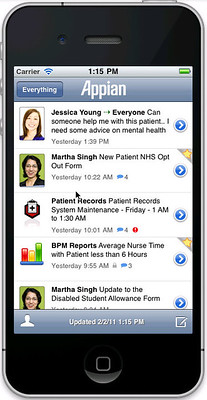
Also interesting is some new packaging and pricing with their cloud starter edition, which combines cloud and on-premise deployments; I see this as a good fit for organizations that need to have their production system on premise due to security concerns, but want to use the cloud for development and testing in order to reduce costs and speed the time to get started. Appian Tempo iPad appIt uses a month-to-month subscription model, although I’m not sure if that includes the on-premise licenses as well, and the ability to quickly set up environments in the cloud with instant on and off control in order to control costs. For some time now, they’ve allowed a process application created in the cloud to be exported and moved over to an on-premise server (or vice versa), allowing developers and testers to use the cloud, then quickly deploy within the enterprise.

He spent some amount of time doing a live iPad demo of Tempo, showing how you can not only consume information, but spawn new activities and interact with events from a variety of systems, including Appian BPM, Salesforce.com and Twitter. As we heard from Matt Calkins earlier today, the Appian app can now be branded by any partner or customer; Malcolm gave us a bit more detail such as how they handle all the admin around things such as submitting it to the Apple app store. He also demoed some of the features that take advantage of the platform, such as use of embedded cameras to take a photo as an attachment.

Matt Calkins Keynote at Appian World

Matt Calkins, CEO of Appian, provided us with some vision around how BPM is changing, and how Appian is delivering on that. They’ve experienced significant growth in sales in the past year, and more than 40% of their business is on their cloud platform.

Their big news, of course, is Tempo: their process event streaming interface that integrates closely with their BPM platform as an alternative interface, and also allows inclusion of events from a variety of sources such as Salesforce.com or pretty much anything with an RSS feed. There are two significant things going on here: one is the ease of use of the interface, and the other is the enablement of mobile. This fundamentally changes how work can get done; I spoke with an Appian customer last night (who will be presenting later today on a panel) about how they will be using Tempo to enable fuel tank inspection operators to update a Tempo-based compliance checklist on their mobile device instead of using paper clipboards, then having to spend additional time back at an office filling out a spreadsheet and emailing it to someone. As we know, in regulated industries, it’s not enough to be compliant, you have to be seen to be compliant; providing this sort of immediate update of compliance data helps with the latter at the same time as you’re doing the former.

In their latest release happening now, you can brand your own application based on Tempo, so that the iPhone app uses your logo and title bar rather than being branded as Appian.

Appian Tempo iPhone appHe poked a bit of fun at how some other vendors are presenting their social business offerings as more about social interaction than getting business done: social may be the delivery mechanism, but the payload is business. Their social platform is focused on integration so that you don’t have your interaction in one system, then login to the “real” system to record what happened; integrating with their own process management plus many other systems means that Tempo is the real system, just an alternative, cooler interface to it.

He moved on to talk about the nature of work, that is, the spectrum between structured and ad hoc work, especially within the same process. I’ve talked a lot about this requirement to have completely unstructured portions within a structured process, and see it in almost every business process that I work on with enterprise clients. He sees this as something that is handled by social business; I see a distinction between dynamic and social, although there’s a correlation.

He did a good overview of the type of people in enterprise today relative to their mobile usage: executives (approvals, reports), headquarters workers (keep in touch), road warriors (initiate tasks, remote collaboration) and mobile task workers (execute tasks, access data). Enterprise applications provide varying levels of support for current business functions, by providing modern interfaces, making business events visible, having native mobile processes and data, and integrating social functionality. For those applications that don’t provide some of the more advanced levels of support, Appian is providing ways to add Tempo as an interface to bring them up to scratch. He sees BPM in 2013 as being focused on the mobile process enterprise: it’s more than just having organizations become process enterprises (which is enough a challenge on its own), but that these processes can be accessed from anywhere. Ambitious, but not undoable.

Gartner Keynote at Appian World: From Operational Excellence To Operational Resilience

The analysts are on the move this week: earlier in the week, we were all in Las Vegas for IBM Impact, now we’re all in DC for Appian World. I presented a BPM 101 session yesterday in the workshop day, and this morning Janelle Hill of Gartner is giving the opening keynote. I’ll be at the Gartner BPM Summit in Baltimore in a few weeks, so I might be seeing this talk again soon.

She’s talking about an upcoming BPM revolution (although it seems more evolutionary than revolutionary, but the R word allowed her to invoke some nice Egypt images) where we move towards resilient processes. By 2020, we’ll see more and more of unstructured processes, dynamic BPM, social BPM, context-aware processes and intelligent operations.

BPM is raising the bar for operational excellence; their basic definition “BPM is a management discipline that treats processes as assets that directly contribute to enterprise performance by driving operational excellence and agility” points to the required attributes of visibility, accountability and adaptability. Gartner predicts that by 2014, business process defects will topple 10 Global 2000 companies; these seems a bit too much like end-of-time predictions, but if you cast the net wide enough, there will sure to be some business failures that can be attributed in part to defective processes. What I do whole-heartedly agree with is that the biggest opportunity for improvements and differentiation are in unstructured processes: these are the ones currently live in email and spreadsheets, and contribute to non-compliance.

There are a number of factors that contribute to operational resilience:

  • Visibility into the pipeline of work allows a front-line worker to dynamically reroute work in order to achieve service goals. I would argue that some of this could be done with automated load balancing, not just manual rerouting, although the concept of visibility would cover that as well.
  • Dynamic BPM allows workers to change or create the process required in order to achieve a goal in a manner that was not envisioned by the process designer. This allows us to consider eliminating requirements (I could so get on board with that) since the creation, prototyping and productionizing of processes can happen so quickly; if this approach scares you, consider that the requirements and design can be a much more collaborative process that allows for continuous change. In fact, she characterizes the requirements-less approach as “fantasy”, whereas I characterize it as “Agile”. I don’t think that Gartner goes far enough here: fully dynamic BPM is possible in some scenarios (excuse me while I dig out my “Process for the People” t-shirt); Phil Gilbert of IBM/Lombardi has stated that we should just put process design in everyone’s hands. Obviously, this is going to be dependent on the types of processes and your corporate culture.
  • Social BPM, including both design-time and runtime, which is something that I’ve been writing and presenting on for 5 years now, brings enterprise social software concepts to BPM – good to see Gartner finally recognizing these ideas front and center. I think that they formerly had a lot of social collaboration ideas tied up in dynamic BPM, which are adjacent but slightly different concepts, but now seem to have split this out.

Her focus is really on challenging the audience on how they define BPM, and how they use it within their own organizations. This means building in resiliency, embracing dynamic processes, figuring out cloud strategy, and harnessing the social interaction that is already going on between people. To quote her closing point, “acceptance of the collective will determine your future”.

Six Steps To Understanding BPM

I recently wrote a series of articles for Global 360 on getting started with BPM; since this was paid content, I didn’t publish them here, but it’s available over on bpm.com (to find the whole series, go here and add a title filter of “getting started with bpm”).

These are now being republished on the EndUserSharePoint site, and will be rolled up into an e-book, which you can register to receive when it’s ready.