Gartner BPM opening keynote: Janelle Hill

I’m here in Vegas for the Gartner’s 5th BPM summit, and I have absolutely no complaints about the wifi. 🙂 They’re reporting about 1000 attendees here (I’m not sure if that includes Gartner and vendors), and I’m sure that those of us who attend these religiously are hoping that this is not a complete replay of the September show in Orlando.

After a brief introduction by Michele Cantera, Janelle Hill gave us Gartner’s big picture view of BPM, which will be covered in detail in other sessions throughout the conference.  Hill seems to be hitting her stride as Gartner’s face of BPM since Jim Sinur left almost a year ago. She started with the now-familiar view of process improvement over the ages, from Deming and Taylorism through TQM, BPR, Six Sigma and a variety of other methodologies and tools since the 1920’s. This has changed from a focus on scientific management, to computerized process flow, to package applications as best practice, to flexible and adaptive process.

Her view of how BPM might change with any coming recession is the same as most that I’ve heard (and agree with): BPM is likely to increase, not decrease, in tough economic times since it helps organizations to run their businesses more effectively and efficiently.

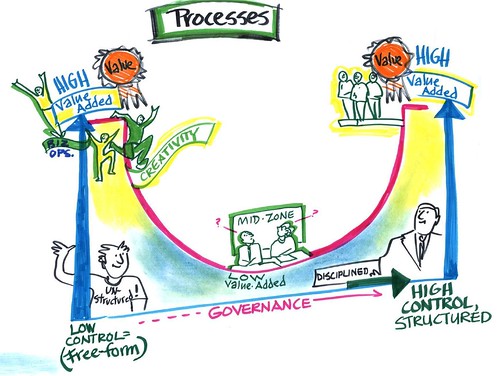
This talk is definitely a rework of her keynote from the last show (even the last two shows); check that out in case I miss anything. As she did then, she focuses on how BPM — both the management discipline and the technology — can support and encourage innovation within an organization. There is a focus on people within the processes, and how to enhance people’s efforts within a process, not just look for ways to automate the human activities: what Gartner is referring to as “the process of me” (seriously). This is key to innovation in business processes; although she doesn’t use the term “emergent applications”, that’s really what she’s talking about: providing process participants with the experience and tools that allows them to express some creativity about how to get the job done better.

She also discussed the impact of compliance and regulations on processes, requiring greater agility and greater visibility, particularly when dealing with regulatory bodies in multiple countries.

We saw a familiar chart showing how although productivity and efficiency is typically the greatest perceived value of BPM today, that will shift to visibility being the most important benefit by 2012, and innovation being the most important benefit by 2017. That doesn’t mean that productivity and efficiency become less useful, but a baseline expectation will be established for these benefits and they will no longer become the most important thing that organizations get from their process management.

Hill changed tack to talk about why BPM technology matters, and the decoupling of process models from the underlying technology into a model-driven architecture. These explicit process models allow business professionals (usually a trained business analyst, but still someone on the business side) to make changes to the process, providing improved immediacy in linking needs to the executing processes, and providing better visibility into the process to see if the changes to the process are actually improving it. This is the driver for a complete paradigm shift, where the business team now owns the process modelling part of the implementation, and IT adds to those models to provide the necessary technical linkages but doesn’t redo the processes in some other tool: the process that the business modelled is what actually runs. By establishing KPIs on the processes, further process improvements can be tracked against those KPIs, and services can be developed to help meet those KPIs within the process context.

Driving to a model-driven architecture means that processes have to be pulled out of the packaged enterprise applications, where processes have been implicit within the applications themselves. The packaged application vendors are starting to expose their functionality as services, and some are even rolling their own BPM as well as allowing other BPM suites to call their services as part of a larger process orchestration. These enterprise vendors, plus the middleware vendors and the BPM pure plays, are all fighting for turf in the current BPMS space.

BPM involves more than just technology: it takes leaders with vision, disciplined culture, BPM expertise and standards as well as the tools. She focused on how technology leaders (e.g., CIOs) need to contribute to the BPM vision and efforts in order to make it strategic, but I also feel that the business leaders need to make the same level of contribution: bringing the B back into BPM.

Gartner has some standard material that they’ve been using for a year or more on what it means to move from a functionally-driven organization to a process-centric one: align roles and responsibilities to the business processes, not by the functional area; business leaders have end-to-end visibility of the business processes; business rules and processes are changed by the business; and there’s more explicit views of handoffs within the process and other points contributing to process optimization. One key point made here is that cost accounting needs to move from being aligned with the functional area to being aligned with the process steps — I’ve seen first-hand how not doing this can cause tremendous problems within an organization attempting to implement enterprise-wide processes.

There are a number of organization issues when dealing with BPM, not just the technology part. In addition to business leadership from a high level, there will need to be process ownership and support from mid-level management, and explicit change management. As mentioned previously, individual process participants also need to be encouraged to look for ways to improve the process, much like the Lean tenet that allows anyone to stop a broken process and offer an improvement.

Hill talked about the type of people that you need for a process-centric organization: people who “think process”. However, I think that we need to have a greater focus on how to take current teams and imbue them with that process orientation.

She also discussed management actions such as creating a governance framework and BPM competency center, appointing specific business process analysts focused on end-to-end processes rather than by functional area, and creating a real-time management culture that is focused more on a view of what is happening in their operations right now rather than through the rear view mirror of historical reporting. There are some specific actions for IT management as well, starting with recognizing that IT should be enabling BPM, not leading it. There’s a lot of groundwork that can be done even if the business is just starting (or hasn’t yet started) BPM initiatives, such as SOA and service definitions.

Her wrapup was on the value of BPM, looking at specifics of cost/efficiency, time/adaptability, risk/compliance and revenue/innovation — a lot of great points here on where the benefits can be expected.

She also mentioned a good fundamental principle for process improvement that came from a customer during a session that she held yesterday: when considering a process change, be driven by how that change will impact the end customer. Excellent words to live by.
Upcoming conferences

I’ll be attending three conferences in the next three weeks (after a hiatus of over two months, it’s going to be strange to get back on a plane), and live-blogging from each conference, wifi permitting.

Next week is the Gartner BPM summit in Las Vegas: one of the key BPM conferences of the year (at least, until Gartner watered it down by running a second one in September last year). The presentations are typically a mix of Gartner analysts discussing BPM, SOA and related subjects, and customers discussing their implementations. The trade show includes every BPM vendor who wants to be taken seriously in this market. Expect to see some of my posts from this week syndicated over on Intelligent Enterprise, plus I’ll be doing a wrap-up article at the end of the week exclusively on their site.

February 13-15 is ARIS ProcessWorld in Orlando, IDS Scheer’s user conference. I attended this last year and enjoyed it; last year was only the second time that I’d been to any sort of process modelling user conference (having attended Proforma’s conference in 2006), and it’s really valuable to see how the front-end modelling tools fit together with the BPMS that automate those processes. IDS Scheer is paying my travel expenses to attend.

February 18-20 I’m back in Orlando for FASTforward, which is sort of a user conference for FAST enterprise search (which is being acquired by Microsoft), but really goes beyond that cover a lot of Enterprise 2.0 territory. Featured speakers include Andrew McAfee, Tom Davenport and Don Tapscott, all of whom I’ve written about in the past couple of week. You can register for FASTforward here, and put my name (Sandy Kemsley) in the reference field so that they know where you came from. FAST is paying my travel expenses to attend. All of my live-blogging posts will be cross-posted to the FASTforward blog, and I’ll do a daily wrap-up post exclusive to their site.

As an aside, I’ve consolidated all posts for all Gartner BPM coverage under one category regardless of year, and all for ProcessWorld under their own category.

If you’re going to be at any of these events, look me up.

BPM, now for dummies

It had to happen: someone is finally grabbing the “BPM for Dummies” (actually, “BPM Basics for Dummies”) title and are running with it.

Software AG is publishing this book very soon (in January, according to their site), and you can register for a free print copy here. According to the description:

Business Process Management (BPM) is useful, powerful and potentially very accessible. But, with so many analysts, consultants, publications and vendors weighing in with their own perspective and opinions, it can be very confusing. Business Process Management Basics For Dummies will help you understand what BPM is really all about. Whether you are a business manager or an Information Technology practitioner, this book will provide valuable information about what BPM can do for you—and how to apply it. This book includes:

  • Core concepts and practical ideas.
  • A primer for getting started with BPM.
  • A step-by-step guide for implementing BPM successfully.
  • A compilation of resources that you can go to for additional help or continued education.

I find it a bit ironic that they seem to be dissing the opinions of vendors (“But, with so many analysts, consultants, publications and vendors weighing in with their own perspective and opinions, it can be very confusing), yet this book is written by three Software AG employees.

Mapping BPM Events

Coincidentally on the same day that Todd Biske and I start collaborating on the BPM, SOA and EA calendar that you can find on both our sites, I saw this amazing post (linked from the Google Operating System blog) showing how to map a Google calendar’s events on a Google map, with a bit of help from a simple Yahoo Pipe. The results, showing our events calendar, can be found immediately beneath the calendar.

The theory is that this should refresh from the pipe (and hence the calendar itself) every time that you visit the page — or, if you prefer, a link to a larger version of the map directly in Google Maps — although I haven’t tested that out.

If you’re an author on the BPM Google calendar, be sure to fill out the location field so that your event is displayed on the map.

Definitely the most fun that I had all day.

BPM Events calendar gains a new audience

Todd Biske, whose blog I read regularly, announced last week that he was going to publish a Google calendar of BPM, SOA and EA events, I invited him to join the one that I’ve been running for a few months. During the time that I’ve had the calendar active, I’ve added about 10 other authors to the calendar who can add events; these are typically people very active in the industry and have events to contribute. If you want to add an event, you can email to either Todd or me; if you think that you can make an ongoing contribution, then let us know and we’ll add you as an author.

You can view the calendar on my site here, or on Todd’s site here. If you have a blog on a related subject, feel free to embed it on your site as well. Good place to check first if you’re organizing an event and want to make sure that it won’t conflict with competing events.

Metastorm’s New Account On-Boarding process pod for financial services

One of the things that Metastorm has released recently is a series of solution frameworks that they call “Process Pods”, which include prebuilt rules, dashboards, KPIs, and technical integrations in addition to prebuilt process models; however, they’re not truly productized in that they’re supported by the Professional Services group as if they were customized work.

The latest of these process pods is targeted at the financial services market, specifically new account opening: an area that often requires both electronic and paper-based data collection, background checks, new account creation, and updates to existing account and client records (Metastorm press release here). In addition to the process flows and rules of other process pods, this one also uses Metastorm Integration Manager product (which is, I believe, what the CommerceQuest acquisition turned into) to integrate the legacy applications (including CICS) that are typically used for client on-boarding tasks in financial services organizations. Although there will still need to be customization, the idea (as with most BPM frameworks) is that the time to deploy a productive, integrated solution will be greatly reduced.

I checked out their hour-long recorded demo of the New Account On-Boarding process pod (registration required, and didn’t seem to be Firefox-friendly). It’s pretty low-resolution and the audio is a bit sketchy, but you can get an idea of how a process would look as implemented with their NAO process pod, including the following features:

  • CICS integration both for retrieving data and creating the new account on the legacy mainframe system.
  • SharePoint portal integration, plus standard JSR168 portal integration into a Pluto portal; there are a number of portlets that can be embedded, such as a task to-do list, a watch list, a search form, and a form to create a new account (which presumably kicks off a new process instance).
  • Email integration for alerting process participants.
  • Data entry forms including links to data validation for things such as customer/account number, and enforcement of required fields.
  • Checks for conditions such as specific countries of origin and amount of investment to trigger any anti-money laundering or other rules for further investigation.
  • Identify verification to satisfy know-your-customer regulations, including checking against third-party blacklist checking services.
  • Risk assessment checklist.
  • Electronic signature and date-stamp at key points, such as completion of due diligence.
  • Removing tabs from user interface at points in the process to limit access to information by certain user classes.
  • Document attachments.
  • After-the-fact batch reports.
  • Dashboards with KPIs; these appear fairly rudimentary, but are actionable by allowing drill-down to the actual process instances.
  • A third (!) separate business intelligence product that also produces reports and dashboards.
  • Administrative functionality to allow control of many of the process parameters via table values, e.g., adding new questions to the risk questionnaire and indicating how each possible answer contributes to an overall score. There are some aspects of this with which I disagree, such as specifying parallel and serial process paths by creating table entries for each logical node in the process map, and assigning the order: this is the way that we used to do process maps before there were graphical process mapping tools.

One issue that I have with the demo is that it shows a finished product from a user point of view, without much of an indication (besides the administration table values) of how much effort is required to build this solution based on the NAO framework, or what is even customizable in the framework. For example, I suspect that some of the processes, rules and data fields in their standard process pod are US-specific, although they should be customizable with some additional help.

There are some things that they sell as features that look a bit clumsy, such as calling out to MS-Word for spell-checking within a note entered in a web form. Also, early in the demo, she shows the process model in ProVision, but not obvious that this maps directly to the Metastorm execution environment — I’ve seen some comments that indicate that it’s not so easy to pass models back and forth.

The demos a bit long, and an interactive demo is always better, but this does take you on a pretty thorough tour of what can be done with their process pod. And, I managed to get all the way through this blog post without a reference to pod people, invasion of the body snatchers, cocoon or many other great sci-fi usages of the word “pod”.

Even public service organizations can ‘camp

Normally I would just provide a link to this in my daily Links post, but this is such a great example of how Open Space technology (e.g., BarCamp, MashupCamp) can be used for more than just holding geeky tech unconferences: last year, three people from the TorCamp community organized TransitCamp to provide a place for the Toronto Transit Commission (North America’s third largest, serving 2.4 million riders each day) and the local community to come together and generate new ideas about how to really make the TTC “the better way”. Today, the story of TransitCamp, “Sick Gloria Transit”, hit the Harvard Business Review as one of their breakthrough ideas for 2008. The article is written by Mark Kuznicki, Jay Goldman and Eli Singer; Mark’s post also contains a number of reference links, including a page of links on the TransitCamp site covering both unconferences and TransitCamp itself.

I’ve attended several unconferences, although I missed TransitCamp last year, and I’ve been promoting the idea of the unconference as a format for business and technology conferences in the BPM space, but it’s a hard sell. One group of conference organizers that I approached with this had many reasons why it wouldn’t work, even though they have never attended an unconference, and most didn’t know what it was before the subject was broached. One response: “hopelessly techie.” I disagree: the unconference format has been used for many non-technical gatherings since Open Space Technology was first defined in 1986; it’s just that the tech community made it popular in the past few years. To quote the Wikipedia article, it “has been used in over 100 countries and in diverse settings, industries, cultures and situations – for program and product design, knowledge exchange, interdisciplinary thinking, conflict resolution and conferences.”

TransitCamp is a great example of how unconferences can be used with a primarily non-technical group of participants to generate ideas for a definitely low-tech endeavour: improving our local transit.