FAST times with McAfee and Tapscott

Usually when I attend a vendor/product user conference, I know quite a lot about the product; this time, however, I’m flying a bit blind. I’m at FASTforward, which is ostensibly the user conference for FAST Search & Transfer, but is actually a lot more than that: billed as “the industry’s largest business & technology conference dedicated to search-driven innovation”, it piqued my Enterprise 2.0 interest when I saw a speaker lineup that includes Andrew McAfee, Don Tapscott and Tom Davenport.

For those of you reading this on my usual Column 2 blog, note that I’m also cross-posting to the FASTforward blog, where I’ve been invited to add my opinions on the conference. For my regular readers, you know that the first thing that I comment on at a conference is the wifi; I can report that there is (slightly flaky) wifi at the conference, although not throughout the hotel. As I always like to point out, tech conference organizers really have to start using open wifi as a serious criterion for selecting conference hotels.

Unlike the usual opening evening of registration and cocktail party, they’re kicking things off with a short address by John Markus Lervik, FAST’s CEO, then presentations by McAfee and Tapscott. The attendance at the conference is an impressive 1200, although I’m sure that they’re not all here yet, which has to be driven in part by the interest generated by Microsoft’s recent acquisition of FAST. Lervik welcomed Microsoft as a platinum sponsor of the conference, which elicited a good laugh from the audience.

McAfee talked about Enterprise 2.0 and what it will take to bring about a world of change. In the past year, he points out, we’ve moved beyond “what”, have some consideration of “why”, and lots of interest in “how” in our Enterprise 2.0 discussions. He went on to present a series of hypotheses about successful Enterprise 2.0 adoption: technologies, projects/initiatives, and corporate culture.

Looking at what the current tools and technologies bring to Enterprise 2.0 success:

  • Tools are intuitive and easy to use — a key to acceptance of the technology, but something that’s also difficult to achieve
  • Tools are egalitarian and freeform
  • Borders seem appropriate to users, so that it’s obvious how far specific information should be shared, and how easy it is to find other people and information
  • At least some of the tools are explicitly social, to allow people to express themselves and find others with similar interests
  • Toolset is quickly standardized

As for initiatives that foster success:

  • Incentives exist, and are soft: incentives for adopting Enterprise 2.0 are not monetary in nature, but are more about making people feel warm and fuzzy about the initiatives; this tends to be difficult in organizations that have had very different incentives and employee reward programs in the past
  • Excellent gardeners exist to accelerate the emergence of structure, whether or not they contribute content
  • Patient and dedicated evangelists exist: those spending their time popularizing the tools and techniques because they believe that they can make a difference
  • Energy and activity are primarily bottom-up
  • Effort has official and unofficial support from the top: both funding and blessings from senior levels to allow evangelists and others to work their magic, but also a mindset that that enterprise is serious about being engaged in the initiatives, such as executive-level blogging
  • Goals are clear and explained: companies have to know why they’re taking on Enterprise 2.0 (e.g., better collaboration), not just because it’s the cool new stuff

Moving on to culture, the key success factors are:

  • People are trusted; as McAfee put it, if the people in an organization wanted to distribute hate literature or pornography, they wouldn’t have waited for Enterprise 2.0 to do it, so don’t assume that providing these tools is going to cause people to change their basic nature
  • Slack exists in the workweek; recognizing this gives people the latitude to blog or create wiki content within the organization rather than appear to be busy when they’re not; organizations that measure employees only on their number of billable hours obviously won’t be aligned with this
  • Helpfulness has been the norm
  • Top management accepts lateralization, which facilitates public content being created by any level within an organization as well as its customers and partners, not just through a sanitized corporate communications process
  • There are lots of young people
  • There is pent-up demand for better sharing, and a good deal of frustration with what the current technologies don’t allow them to do

His conclusions:

  • Enterprise 2.0 is going to increase differences between companies, more clearly separating winners from losers: the winners have greater willingness to embark on innovative strategies, more sincerity of effort and greater ability to execute. Personally, I think that this is a bit of a chicken-and-egg argument: are the companies more successful because they adopt Enterprise 2.0, or do they adopt Enterprise 2.0 because they recognize innovative application of technology as a key to success?
  • These differences will be important, making companies more responsive to market and other changes, do a better job of knowledge capture and sharing, and harnessing the collective intelligence.

We then heard from Don Tapscott. I’ve heard him speak several times, including at last year’s Enterprise 2.0 conference and in a webinar last month, and there was some amount of repetition here as he discussed the new enterprise. The four drivers for change as he describes it are:

  • Web 2.0, including such underlying innovations as broadband penetration, geo-spatiality of pretty much any device that’s networked, true multimedia blurring the line between live action and animation, standards-based web services and the integration that they enable.
  • The net generation, representing a demographic revolution of kids who grew up digital without fear of technology; they spend more time on their computer than watching TV, and much less time watching TV than their baby boomer parents. Tapscott feels that they’re developing amazing mad skillz in technology, although some recent studies have shown that this just isn’t true (except maybe from the standpoint of someone who struggles with technology). What is revolutionary is how they interact with the technology, creating new social ways of doing things that we old-timers just never thought of doing.
  • The social revolution and the rise of collaborative communities like Flickr, YouTube and Facebook to beat out the old-style competition. This is a direct outcome of what I mentioned in the previous point, namely, that the net generation is creating new ways of social interaction on the web.
  • The economic revolution, full of completely new and disruptive business models, like Google and eBay: digital conglomerates building on the economics of collaboration. Business models have changed from traditional, vertically-integrated industrial-age corporations to extended enterprises to business webs to mass collaboration amongst loosely-coupled entities.

He discussed the Goldcorp case study from his WIkinomics book: Goldcorp published their secret geological survey data and offered a prize for whoever could analyze it in a way that would help them to find more gold; they had submissions from all over the world, awarded a few hundred thousand dollars in prize money, and made over $3B in new gold finds. Now that’s mass collaboration.

Tapscott listed seven different business models that harness mass collaboration, also from Wikinomics:

  • Peer pioneers (e.g., Spikesource and other open-source based enterprises)
  • Ideagoras (open idea markets, e.g., Proctor & Gamble, who have half of their innovations come from outside of the corporation)
  • Prosumers (where customers become producers, e.g., Second Life; the music industry with third-party remixes)
  • The new Alexandrians (the sharing of science, e.g., human genome project)
  • Open platforms (e.g., Amazon APIs to allow developers to create new applications on top of their platform, which now generates 1/3 of their revenue)
  • The global plant floor (e.g., Boeing creating the 787 as a peer-produced aircraft with their suppliers)
  • The wiki workplace (transforming the way that an enterprise works through the application of Enterprise 2.0 tools such as wikis for collaboration, e.g. Geek Squad product management within Best Buy)

He closed with the thought that this is a time of paradigm shift, which in turn creates a crisis of leadership: new paradigms are nearly always received with coolness, even mockery or hostility, as those with vested interests fight the change. Paradigm shifts involve dislocation, conflict, confusion and uncertainty, and demands such a different view of things that established leaders are often last to be won over, if at all. Instead, this is calling forth a new generation of leaders from the collective enterprise, with different attitudes and different skills.

My coverage of FASTforward will continue tomorrow, flaky wifi permitting; I’m off to schmooze with the other FASTforward bloggers.
A chance encounter with jBPM

In one of those weird coincidences, JBoss World is happening simultaneously in the same conference center as ProcessWorld; Tom Baeyens noticed that I was blogging from ProcessWorld and contacted me, and we had a chance to meet up today.

We had a great discussion about model-driven applications, and finding the dividing line between what works and doesn’t work in a model-driven paradigm. Tom’s premise is that model-driven development can work in simple cases, but that it’s not possible to generalize: at some point, enough technical underpinnings need to be added to the model that it’s no longer understandable by a non-technical business analyst. Although the business analyst can still create a model and pass it for translation to a developer for augmentation, it’s going to be a one-way trip in most cases.

I definitely see some validity to this position; what typically ends up happening in today’s model-driven development in BPM is that either the developers just take over maintenance of the models at some point (even if the tool allows the models to be shared), or the business analysts learn enough of the technical side to be able to understand the fully-executable model which is, unfortunately, no longer really a business model.

jBPM is not at all about model-driven development, but provides a BPM engine that can be embedded directly in your Java code. Tom shared some of his vision of the future for the project with respect to expanding modeling capabilities and other areas; suffice it to say that total BPM world domination is on the plan.

ProcessWorld 2008: Interview with Georg Simon

I had a chance for a private interview with Georg Simon, director of ARIS solutions, to get a bit more detail about their upcoming (March) release and other product plans for 2008. I was especially interested to hear about what’s happening with the execution engine to which Dr. Jost referred in his closing keynote yesterday.

The big news in the upcoming 7.1 release is model versioning, a long-awaited feature that allows you to see graphically how a model has changed between versions. In retrospect, I can’t see why they didn’t do this long ago; it seems like an obvious key capability and customers must have been crying for it. The new WYSIWYG report generator also seems like it’s a bit late to market. They’ve added some new Six Sigma support, as well as event monitoring as part of their monitoring and management offering.

I think of ARIS primarily as a modeling environment, but many of their customers also use their PPM process monitoring tool as well, which allows process measurements to flow back from the execution environment and be displayed and compared relative to the original models. As well as offering this directly, ARIS PPM is also bundled into some BPMS vendors’ monitoring capabilities, including TIBCO and Fujitsu.

Looking ahead to what will be released by the end of 2008, I was most interested in finding out about the execution engine; Simon stated that this will be for “non-operational” processes such as release cycles, and the processes that govern the creating of artifacts within ARIS. They’re service-enabling their platform so that it will both expose services and consume services, which means that it will be able to be called from other BPMS environments for similar functionality, and they admit that they might compete with low-end human-centric BPMS for non-operational processes. It appears that they’re avoiding any mention of operational processes because they don’t want to perceive to be in any sort of competition with their main partners, such as SAP, IBM and Microsoft.

They’re also planning to release some new risk and compliance management capabilities, not tied to any specific regulatory requirement but flexible enough to allow partners to build out vertical regulatory compliance solutions. Of course, they’ll have some of the big standards, such as SOX and Basel II, available out of the box but still customizable.

There’s also some new things coming allowing mashups of their monitoring capabilities in order to allow people to build their own dashboards, instead of being restricted to just customizing the out-of-the-box dashboard; I see this as a definite trend in process monitoring capabilities, and think that most vendors need to open up their monitoring environment using a variety of lightweight techniques such as JSR168 and RSS to meet future needs.

ProcessWorld 2008: Maureen Fleming, IDC

Maureen Fleming of IDC spoke in the Process Intelligence and Performance Management track on process measurement, and how it’s used to support decisions about a process as well as having an application context. She defines strategic measurement as guiding decisions about where to focus across processes, providing information on where to improve a process, and supporting fact-based dispute arbitration.

She showed a chart of timeliness of measurement versus complexity:

  • Simple and timely: measure and spot-check performance within a process
  • Simple and time critical: need for continuous measurement and problem identification within homogeneous processes
  • Complex and timely: regular reporting to check performance across heterogeneous process islands
  • Complex and time-critical: need for continuous measurement and problem identification across heterogeneous process islands

Leading enterprises are moving towards more complex measurement. I’m not sure I agree with her definition of “timely”, which seems to be used to mean “historical” in this context.

She breaks down measurement tools by the intention of the measurement system: what happened (process intelligence and reporting)/what will happen(analytics, complex event processing)/what is happening (BAM)/why it is happening (root cause analysis))/how we should respond (intelligent process automation).

She went through IDC’s categorization of BPMS — decision-centric automation (human-centric), sensing automation (integration-centric and complex event processing), and transaction-centric automation (integration-centric) — and discussed the problem of each BPMS vendors’ individual BAM creating islands of process measurement. Process metrics from all process automation systems need to feed into a consolidated process measurement infrastructure: likely an enterprise process warehouse with analytics/BAM tied to that more comprehensive view, such as ARIS PPM.

She discussed KPIs and how the goals for those KPIs need to consider both business objectives and past performance: you can’t understand performance variations that might occur in the present without looking at when and why they occurred in the past.

Although her presentation mostly focussed on process measurement, the Q&A was much more about sense and respond: how to have specific measurements/events trigger something back in the process side in order to respond to an event.

ProcessWorld 2008: Customer panel

Dr. Dirk Oevermann, who heads up IDS Scheer’s consulting operation, hosted a discussion with two customers, Zak Mars of GraceKennedy and Chris Meiser of Tallard Technologies, about their best practices with ARIS for enterprise software roll-outs. There is an ARIS SmartPath model for implementation, using templates/frameworks and consulting services; originally targetted at small and medium businesses, they’re now finding traction with it in large businesses as well. This morning’s panel included two medium-sized companies that used ARIS SmartPath for their SAP implementations.

GKFoods (part of GraceKennedy) has a widely distributed food manufacturing and distribution organization — 5 manufacturing facilities, 6 sales and marketing organizations, 8 major distribution centers from their corporate headquarters in Jamaica — and decided in 2005 to bring in SAP to replace the 9 different systems then in use, providing better visibility into their operations, reducing redundancy and more fully integrating their operations. They credit ARIS SmartPath with allowing them to meet their 18-month target for roll-out to 12 companies, and since their implementation, have leveraged what they built through another major acquisition and the build-out of other integrated functionality such as sales force automation and vendor payment automation. They plan to use the same templates and best practices to continue this growth in 2008 with another new acquisition plus undergo an SAP version upgrade as well as the implementation of capacity planning and HR modules.

Tallard is a value-added distributor of hardware, software and services in Latin America, with 300 employees in 8 countries and a network of 1000 resellers, retailers, VARs and integrators. They implemented SAP and IDS Scheer starting in 2000, and since then have grown from $40M to $220M in revenue; managing that growth across multiple countries and 3 languages has been a key challenge. ARIS SmartPath helped them to align their business processes across the regions. They use the ARIS toolset to design and document their overall business processes in a centralized repository, ARIS Web Publisher to provide enterprise-wide access to the process documentation and attach manuals, and ARIS for SAP NetWeaver for SAP process design. They learned some valuable lessons, particularly that of obtaining executive support: first promoting process modeling as a tool to improve sales and efficiencies, and second as a tool to document and train internally. They also found it essential to hire dedicated resources, such as a business process architect, and provide adequate user training in order to facilitate active use of the tools.

ProcessWorld 2008: Business Process Excellence Awards

We closed off the day with the IDS Scheer Business Process Excellence awards in six different categories:

  • Boeing, for business-driven SOA management
  • ENMAX Energy, for process-driven SAP management
  • Bayer, for process intelligence and performance management
  • MacGregor Golf in the small and medium enterprise category
  • E2E in the partner innovation category

Unfortunately, I missed the name of the company who won in the enterprise architecture management category — a mining company headquartered in Brazil — but it should appear on the IDS Scheer site at some point soon.

Update: the winner in the enterprise architecture management category was VALE. Thanks to Mark Tordik of Springboard PR for noticing my gap here, and taking the time to follow up.

ProcessWorld 2008: Dr. Wolfram Jost

The final keynote of the first day was given by Dr. Wolfram Jost, who has responsibility for the ARIS product line. I have a bit of difficulty sorting out the European titles sometimes; his title is “Executive Board Member responsible for products”, which in North America would translate to “VP of product management” or something similar.

He makes a distinction between the “business layer” and “technical layer” of BPM, where the technical layer appears to be defined as the BPMS and other systems (such as SAP) that are used to execute business processes, and the business layer (ARIS) is used to monitor and manage the performance of the processes. Interestingly, they’re putting performance management ahead of modeling in importance, even though they’re likely better known for modeling; performance management is much more closely tied to process improvement in people’s minds, even though you likely wouldn’t get to that point if you didn’t model the processes in the first place, and the models provide a framework on which to hang the measurement data.

Jost sees a convergence of major improvement initiatives within organizations: BPA/BPM, SOA, EA, BI and GRC (governance, risk and compliance). To address this, ARIS is bundled as solutions to approach these initiatives on top of the base ARIS platform.

He covered some of the new functionality in the upcoming product release with respect to modeling:

  • Versioning of models
  • WYSIWYG report designer
  • Timeline display of models

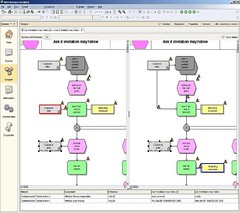
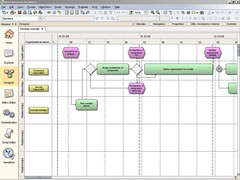
ARIS Business Architect 7.1 - Versioning and model comparison ARIS Business Architect 7.1 - Time-based modelling

He also reinforced how they provide a standard modeling and performance management platform for a number of different implementation platforms, from ERP platforms such as SAP to BPMS such as TIBCO or Fujitsu.

There’s some completely new functionality in this product release as well, such as the IT Inventory capability.

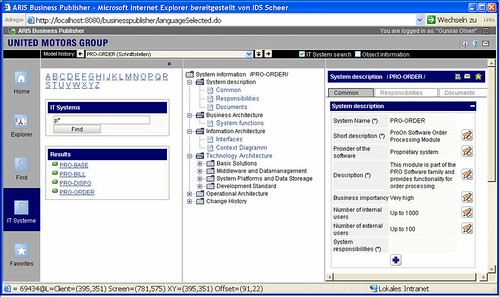
ARIS IT Inventory 1.0 - Overview

He went on to discuss how by the end of 2008, they will release a process execution environment “for governance processes”, the subtlety of which escapes me somewhat — does that mean that they are about to become a full-up BPMS, or only for specific types of processes? If they do release an execution environment that operates directly from the models in their repository, they’ll definitely annoy some of their  BPMS business partners, but more importantly, they have the potential to become one of the most powerful BPM suites around because of the top-notch modeling and performance management. I have an interview tomorrow morning with someone in product development that should help to clear up my fuzziness on this — tune in then for more.

ProcessWorld 2008: Michael Blechar, Gartner

You would think that I had enough of Gartner last week in Las Vegas, but here I am at yet another Gartner presentation.

Although Gartner is a big proponent of buying everything in a BPM suite (including modeling) from one vendor, Michael Blechar is here to play nice and talk about best-of-breed modeling and analysis using tools such as ARIS — even going so far as to refer to it as the “Cadillac of BPA”. They completely underestimated the interest in this track, and the room is standing room only.

He looked at the three major types of BPA tool buyers: business process modelers, (enterprise)architects, and BPMS modelers (who are concerned with the actual implementation within a BPMS execution environment, hence focused on design and construction). BPMS modelers typically start with the modeling tool provided by the BPMS, then may add in a more comprehensive modeling environment after implementing one or two processes and finding that the modeling tool is inadequate, whereas business process modelers are typically creating models independent of any particular execution implementation. In many cases, business process modelers are starting with Microsoft Visio because it’s the most readily available tool, but find that they need something much more robust for modeling, providing functionality such as activity-based costing and simulation.

He reviewed the players in the recently-published BPA magic quadrant, where IDS Scheer sits as the clear top-right leader. This market is undergoing a lot of consolidation, mostly as BPA vendors are being acquired by BPMS vendors; surprisingly, the magic quadrant only has leaders and niche players (bottom left), but nothing in the challengers or visionaries quadrants. Personally, I wouldn’t have put Microsoft (with Visio) in the leaders quadrant; although they are clearly a dominant force in the market, their product is pretty low-end compared to the real contenders: IDS Scheer, Proforma, Mega, iGrapfx, Telelogic and Casewise.

Blechar is talking about how in the future, Microsoft and others will allow you to create models that actually execute without writing code, but isn’t this what almost all BPMS products do now? There’s some confusing stuff going on in this presentation from a BPMS viewpoint, such as talk about the convergence of BPMN and UML, and an over-emphasis on BPEL as a cornerstone.

He finished up with some recommendations:

  • When BPM initiatives reach the point of requiring business architecture definition — or there is a need to visualize, simulate, animate or automate business process as models — BPA tools should be implemented.
  • As business look to implement business processes in a service-oriented architecture, there is an increased urgency to collaborate more closely with IT archtiects and analysts including shared models.
  • Be pragmatic in scoping modeling efforts: do not try to “boil the ocean” in terms of modeling the “as-is” and “to-be” business architecture and processes.
  • Ensure the key business roles of business process owner, architect and analyst are staffed and enabled.
  • Monitor standards efforts and be prepared to use increased model automation tools and techniques.
  • Match BP methods and tools to the primary focus group of usrs – be they BP modelers, architects or BPMS modelers.
  • Monitor opportunities to purchase pre-built models to jump-start your BPI projects.

ProcessWorld 2008: Prof. Dr. August-Wilhelm Scheer Keynote

I had completely forgotten last year’s jazz performance until Dr. Scheer arrived on stage for his keynote toting a saxophone, and had a quick session with bass, keyboard and drums before starting the keynote.

His presentation focus was on a framework for business performance management: a holistic management concept for improving performance and profitability of a company via two BP(e)M [Business Performance Management] wheels. He started with a content wheel that included several of the dimensions along which to consider business performance management initiatives, through three phases of market maturity (roughly, pre-2000, 2000-current, and future). For example, “objects”, or the artifacts captured to drive the frameworks, has shifted from data to processes, and is starting to move to events and rules.

He moved on to a technology wheel model, covering various aspects of application architecture, as they moved from standalone process models to tight integration with ERP packages — which effectively acts as the business process execution layer — to the emerging generation of model-driven business software.

He overlaid these wheels with areas covered by classical BI and BPM to show the gaps between ARIS and other classes of products, and showed how it could be used for evaluating process improvement efforts to date within an organization.

ProcessWorld 2008: Opening Keynote

Charlie Doucot, head of IDS Scheer’s North American operations, opened the conference by talking about their growth in the past year, particularly in their new and growing partnerships with Microsoft and SAP. SAP has a huge presence at this show — one of this morning’s three tracks is “process-driven SAP management” — and I’m looking forward to seeing more of what they’re doing together, especially since it now looks like I’ll be attending SAPPHIRE in May.

Thomas Volk, president and CEO of IDS Scheer, talked to us briefly about the rise of the operational CEO, who

  • sets objectives prescriptively
  • manages accountability objectively
  • monitors execution constantly
  • sees potential problems early
  • makes adjustments regularly

in order to return shareholder value, increase market valuation, grow the top line, and mitigate risks. He sees ARIS as providing “corner office command-and-control of the operational strategy”, which I think is a great phrase to describe how today’s executives need to keep an eye on what’s happening in their organizations at a high level.

I missed the press briefing this morning (through no fault IDS Scheer’s excellent press relations, but through my own inability to read a schedule), but there were a number of announcements there as well. From their press releases:

  • A technology partnership with Minitab Inc., a quality improvement software and services provider, that will offer joint customers an integrated solution for Six Sigma, a rigorous methodology that uses data and statistical analysis to measure and improve a company’s operational performance, practices and systems.
  • An integrated offering of ARIS Business Architect and the BMC Atrium CMDB product, which enables the design and building of IT Services based on business processes.
  • A process-based solution for the fabricated metals industry that has received official qualification from SAP AG in the United States and Germany – the new ARIS SmartPath for Fabricated Metals.
  • A three-year partnership agreement with the Supply-Chain Council (SCC).
  • The completion of the first phase of a business transformation initiative at Intrum Justitia, a European credit management services company, successfully transforming a legacy application into a Business Driven SOA using the ARIS Bridge integration from IDS Scheer and E2E.