Workflow and BPM Open Forum #sapphire09

It’s the last session of the day – and for me, for the conference – and I’m attending the open forum on workflow and BPM hosted by a number of people from inside and outside SAP with experience in different workflow and BPM areas. The format was 100% audience Q&A, and the focus was really on the SAP Business Workflow within the core ERP system, not NetWeaver BPM; this isn’t completely surprising considering that BPM just went into unrestricted release this week, so there’s probably not enough of it in the wild to generate much of a discussion on it.

There was an interesting discussion on what types of processes and applications lend themselves to being “workflowed” – time-sensitive (deadline monitoring), review and approval, audit and control requirements – which was not specific to the workflow/BPM platform.

Unfortunately, not enough content for me, since BW is too buried within the ERP to be of interest to me, and I ducked out early.

Ginger Gatling on the Universal Worklist #sapphire09

I spent yesterday and this morning in the global communications center at the north end of the conference center, since SAP’s teams for managing social media (that’s us bloggers), press and analysts brings the SAP executives to us for meetings up there. They pipe in the keynote sessions, give us comfy tables with internet access, power and printers, and feed and water us; I’m guessing that some of the press/bloggers/analysts never venture out of the global communications center all week. I just can’t resist the call of the regular sessions, however, and I hiked through the extensive show floor to the south concourse for Ginger Gatling’s session on the Universal Worklist (UWL).

This session isn’t specifically about BPM, but the UWL is used as the common inbox portal for tasks from a variety of sources including BPM and business workflow. This session was for people who use UWL already, with Gatling’s top ten recommendation for configuring it for better usage.

Almost no one uses UWL out of the box – only one person in the audience claimed to be doing this, and even they have recently started to customize it – since there are a variety of ways to customize it: processing of multiple tasks in the list simultaneously, forcing comments/responses when specific actions are taken, override the default task launch mechanism, create custom action buttons, or just basic visual styling. UWL can also handle non-SAP tasks: a task from any application can be integrated by using the UWL Java API to create a UWL connector for that application. In fact, that’s how NetWeaver BPM tasks end up in the UWL. There were a couple of people in the audience interested in using UWL for non-SAP tasks, with one of them stating that they had 19 different workflow systems and want to use UWL as their “window to everything”.

Interestingly, although UWL can be personalized by users, almost everyone in the audience said that they hide that option because it makes it harder to support. This is pretty basic personalization, such as column order and sorting, but it’s amazing what people can get confused over, especially when they’re trying to explain it to a remote support person. Also, most of the audience disable substitution (that is, redirecting your tasks to someone else while you are away) at the UWL portal layer, since there could be several applications surfacing tasks into UWL, and you can’t apply the same substitution rules across all of them. Both of these – personalization and substitution – are examples of features created by developers who don’t really understand the business environment, but were likely designed and tested in an overly simplistic version of that environment: otherwise, who would assume that all of the tasks in a “universal” worklist could be delegated to the same person?

This is not something that I will ever have to do myself, but it’s an important glimpse at what sort of customization needs to happen for a BPM application that is going to use UWL as an inbox, in addition to the customization that is done for the task user interface itself within BPM.

Wolfgang Hilpert and Thomas Vollmering on NetWeaver BPM #sapphire09

I started to get paranoid yesterday when my meeting with Wolfgang Hilpert and Thomas Vollmering was scheduled at the same time as Ginger Gatling’s session on NetWeaver BPM, then they didn’t show for the meeting – was there something they didn’t want me to know? However, it was just a scheduling glitch, and eventually we met up so that they could brief me on the current release and what’s coming later this year.

When I last had an in-depth look at the product late last year, it was in late beta; since then, it’s been through the SAP ramp-up (early ship) process, and was released for unrestricted shipment on Monday. I’ll be finishing up my review of the current release in an upcoming post, and as soon as Thomas forwards on the material that he promised to send (hint, hint), I’ll be able to post a bit more on the future directions.

The newly released version is still lacking a lot of expected BPMS functionality, but has focused on the features that SAP’s customers said that they needed the most: human-centric BPM (since there are existing products in the SAP suite that cover lower-level orchestration) and a integrated composition environment that can eventually be used for process composition across all layers: human-facing tasks, web services, and core ERP processes. Due to their Yasu acquisition, they also did direct integration between the BPM and BRM environments, although there were some rough edges there and in some of the other areas, such as handling the user interface at process steps.

In spite of the shortcomings of the first release, SAP’s vision for BPM is far-reaching, especially around the integration of events and analytics. They are taking advantage of the innovation that’s happening within the BusinessObjects group, and there’s a potential for them to create a powerful platform not just for managing processes, but for handling events, including the results of analytics at a human-facing step as a decision-support tool, and for analyzing and optimizing processes.

Marge Breya on BusinessObjects Explorer #sapphire09

A small group of bloggers had the opportunity to sit around a table with Marge Breya to expand on what we saw during the press conference on BusinessObjects Explorer. She discussed how unstructured data has being elevated to first class status within SAP, with analytics and reporting tools that can lay over unstructured as well as structured data. Part of this involves parsing structure out of unstructured data through an appropriate semantic layer.

They’re also playing with things (that she couldn’t really talk about, although some customers have access) that provide much more of an hosted Web 2.0-type of experience. They’re working on Explorer On Demand, which allows you to upload spreadsheets and other file-oriented data, then do some analysis and visualization on your own data to get an idea of how valuable tools like this are. They handed out some test drive passes for this, so I may get a chance to play around with it some time soon. I expect that many organizations won’t want their data warehouse in the cloud, but this will at least give them a chance to try it out in a no-risk environment. They’re doing this with more of their BusinessObjects platform, where there’s a free version that allows for some starter functionality, then hope for it to go viral in terms of stepping up to paid on demand or on premise versions. That’s a pretty powerful model in the consumer space, although traditional enterprises may have a more difficult time adopting technology in this manner. Considering that the higher-end of Explorer is targeted at large organizations, this could be the biggest challenge.

Breya had some interesting background on product strategy as well, especially around how SAP had traditionally been doing OLAP-based business intelligence, and BusinessObjects didn’t have much in the way of OLAP, so the acquisition produced a minimum of overlap. Polestar, on the market for a couple of years as an ad hoc query tool, was retooled into Explorer for a million or so rows of data, and Explorer Accelerated, a software and hardware bundle, that can handle billions or rows.

She went on to talk about the ties between BI and BPM, and although she couldn’t talk about anything specific, there are some interesting things coming in terms of operational BI, monitoring and characterizing processes for the purposes of process improvement, as well as invoking analytics within processes for decision support.

In response to a question about the consumerization of SAP products, she promises us “an experience that will take decisioning to the next level, involving collaboration” in something that is just entering private beta now. I’m picturing a cross between Xbox Live and Vanilla Sky, which would be cool, but I still think that there are challenges to adoption of completely new user experience paradigms. Since SAP has a wide customer base in manufacturing and other industries with low margins and the requirement for constant product innovation, this may not be as much of a challenge as it would be verticals such as financial services and insurance.

We had a discussion about the cloud versus on premise as the location for data, with the underlying theme that it’s not an all or nothing proposition: while operational data may be behind the firewall, it makes much more sense to leave third-party benchmarking data in the cloud where it can be shared and frequently updated. The new generation of BI products from any vendor can’t be restrictive in their data sources, but have to be able to aggregate information from a variety of sources both inside and outside the firewall.

#sapphire09 press conference – Business Objects Explorer

Jon Schwarz, SAP Executive Board Member, gave the global press conference at SAPPHIRE this morning, with a focus on BusinessObjects Explorer (formerly known as Polestar) and how it helps their customers to become clear enterprises: seeing, thinking and acting clearly. As Prashanth Rai twittered, it’s more like a mini keynote than a press conference, or at least this part of it.

SAP is seeing a fundamental change in customer expectations, both from the buyers and the users. Buyers need to do more with less, which means reducing total cost of ownership, making it easy to deploy solutions, and getting to ROI faster. Users now want the same level of usability and sophistication of digital media as they see in consumer applications (surprise!), as well as wanting to integrate social and community aspects.

Their strategy:

  • Building on their core business process platform
  • Best foundation for an intelligence platform since the acquisition of Business Objects
  • Next-level BPM, presumably through NetWeaver BPM (although he didn’t state that explicitly)
  • On premise and on demand solutions
  • Web 2.0-like user experience
  • Non-disruptive evolution through timeless software

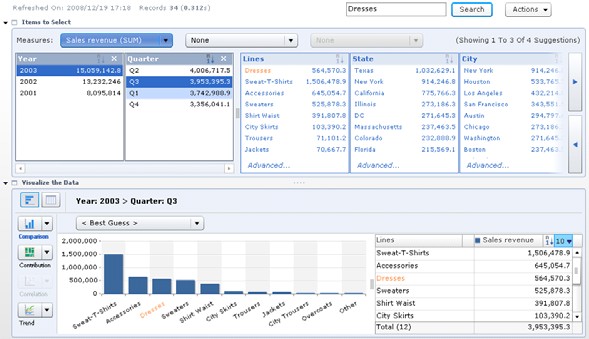
Marge Breya, EVP and GM of Business Objects and NetWeaver, took the stage to talk about how data is used within organizations, and pointed out a 2007 BusinessWeek research study that showed that most people don’t think that they have the right data (and granularity of data) to do their job, and poor decisions are being made due to lack of information. She then introduced BusinessObjects Explorer, a front-end tool for exploring and visualizing large data sets, both for casual and power users. It allows for searching and sorting, interactive drilldowns, and various types of dynamic graphical visualizations while navigating through the data. This can be done in the context of a SAP report screen, and she showed an experimental version running on an iPhone. In the next year, they’ll be opening up the data sources so that this can be used as an interactive analysis and visualization tool against data warehouses, flat files and other data sources. Currently, there’s a regular version, which good for up to about 1M records, and an accelerated version for much larger data sets. There are, of course, other data analysis and visualization tools in the BusinessObjects portfolio: Xcelsius, Crystal and WebI; the challenge will be a clear delineation of the usage of each of these products, or a consolidation of some of these to create a more compact portfolio.

She was then joined on stage by a panel of customers and partners: Vincent Vloemans from Sara Lee, Katrina Coyle from Molson Coors, Elke Reichart from HP and Alexander Yost from IBM. The two customers have been using Explorer and had lots of good things to say about the speed of analysis (2-3 seconds on data sets of 300M records), the fast learning curve for users with little or no training, and the short time to value. The partners discussed how their hardware optimizes the performance of this solution – apparently, a nice IBM or HP blade server will help things out considerably – and how they are shipping preconfigured and optimized systems.

Schwarz came back up to walk through a more traditional set of press announcements, including their acquisition of Clear Standards; you can read all of the news releases in the news room. We then had an audience Q&A, which ranged across a variety of subjects including the potential for appliances for products such as BusinessObjects Explorer (nothing to discuss yet, but apparently in the works), the role of business and IT in the creation and maintenance of data visualizations and other user-facing information (don’t fire your IT staff yet), sustainability (they’re for it), and the necessity for good data hygiene (seriously).

If you’re on Twitter, #sapphire09 is one of the top trends today. With 10,000 attendees on site and another 8,000 registered online for virtual participation, that’s not surprising.

Back to blogging

I’ve been absent from blogging for a while – with the exception of the links posts that are auto-generated from my Delicious bookmarks – due to a very heavy client workload and very few conferences to blog about. I have been twittering, but my Twitter stream tends to contain random thoughts and personal observations rather than BPM-related commentary.

The Twitterati may claim that blogging is dead, but there’s clearly a place for articles, reviews and opinion pieces that need more space to expand on a subject. There’s something about writing longer bits of prose (longer than 140 characters, that is) that helps my brain work around problems better, plus the comments and feedback from readers is a valuable part of the conversation. I plan to get back to more regular blogging, and to kick that off, I’ll be blogging from SAP’s SAPPHIRE conference this week in Orlando. I have a detailed review of NetWeaver BPM that has been in the works for a while, and I’ll be updating that with new information from this week and publishing that as well.

Stay tuned, and don’t delete me from your RSS reader yet.

In Honour of Ada Lovelace

I pledged to write a blog post for today, Ada Lovelace Day, in honour of a woman in technology who I admire. Although there have been some great women in technology throughout history – Grace Hopper comes to mind, and is the subject of many blog posts today – I wanted to write about someone who I know personally, and who I feel has contributed to my personal or professional development.

I didn’t have any women mentors in the early part of my technology career. I went to a high school in suburban Toronto during the mid-70’s where I had to fight to be admitted to the technical courses, and my mentors there were two male teachers who helped get me gain entry into the courses, then taught me the right (and wrong) way to wire circuits and design mechanical gearboxes. I moved on to engineering at University of Waterloo, where I recall one female professor and one woman teaching assistant during the entire time, neither of whom had a lasting impact. I did my work terms at mines, pulp mills and oil companies in northern Ontario and Alberta: again, not many women around. I came to believe that I didn’t need to have other technical women in my life, since I was doing just fine with male mentors (a convenient belief, considering that was my only choice).

That started to change when I owned a software services company, and was growing it to its eventual size of 40 people. As CEO, CTO and chief cook and bottle-washer, I was involved with pretty much every technical hire that we did. And something completely unintentional happened: I hired a completely female technical management team, all of them talented computer scientists and engineers, and also capable of leading teams. It wasn’t about equal opportunity or any crap like that, it was about finding people who not only had mad tech skillz, but who I trusted to run some part of my company, who understood my vision for it, and who could mentor the people on their teams. They just happened to all be women. That changed something for me. I realized that although I had learned a lot from the male mentors in my life up to that point, I had a lot to learn from the technical women around me, too. These women taught me that collaboration and compassion are not at odds with technology, but enrich it: this was in the late 90’s, when technology was still hard-edged, and the word “collaboration” wasn’t a part of most of our vocabularies.

That’s a lot of preamble, but when I sat down to write this, I felt compelled to explain why my first women tech heroes didn’t come along until I was already 20 years into my technical career. Since then, there have been many more, but I want to go back to one of those first ones with whom I entrusted a huge part of my growing team, Marion Cameron. Marion is a former developer, the best project manager who I’ve ever worked with, and was a tremendously calming and mentoring influence over my growing team of (mostly male) developers. She had stopped programming before I met her, but she has a degree in computer science (also from Waterloo) and spent some amount of her younger years working on contract as a developer in other countries, including a stint in Vietnam while there was a little armed conflict going on there. When I met her, she was a project manager working for one of my customers; she moved on, but when I was later looking for someone as our first project manager hire who could grow into a much more senior position, we tracked her down. As we grew, she took on the management of all project managers and developers, although we eventually split the role so that she could focus on the project management team.

One thing that Marion taught me is that you don’t need to raise your voice to make yourself heard. Petite and soft-spoken, Marion commanded respect from our team and our customers because she knew her stuff, and because she was committed to making sure that the right thing happened. I have heard her raise her voice only once in anger the entire time that I’ve known her, and she did that in private in my office rather than in front of our team or customers. I can’t say that I’ve stopped raising my voice or saying totally inappropriate things sometime, but it certainly seems to be a lot less frequent, and I credit her with helping me to understand the value of taking a moment to think about what I’m saying before I blurt it out.

Another key thing that she showed me was how to bring collaboration into a team. She is a natural collaborator, and manages to find the right path to a solution while gaining consensus, but without that devolving into endless rounds of meetings. I know that if we had had collaborative tools such as wikis back then, she would have been the first to find a way to use them to great effect.

She also taught me a lot about managing people, particularly that strange and wonderful group of developers that made up our team at the time. Most of them were young, talented and a bit full of themselves, prone to bruised egos and always testing the limits. She nurtured them in a variety of ways depending on the individual and the circumstances: part skills mentoring, part coddling, part constructive criticism, and always a healthy dose of respect.

Marion helped me to be a better technical leader, and ultimately a better person; for that, I dedicate my Ada Lovelace Day blog post to her.

Next week: Toronto, not San Diego

Yes, it’s true, I’m going to miss a North American Gartner BPM summit for the first time in, well, maybe forever. There’s two reasons for this: first and foremost, I’m 110% busy with time-critical client work right now, and a week in sunny San Diego just doesn’t fit into my calendar. Also, if you review my coverage of last fall’s summit, I’m not finding enough new material at each summit since they moved to the two/year format: I’m not learning much, and there’s not much new to write about. I believe that they’ve started to add some new material specific to BPM in a tight economy, and they had a pretty successful event in London a few weeks back, so I look forward to catching up with the material – and those of you attending – at the next one.

For all of you who have sent messages asking if we can meet up in San Diego next week, I’ll raise a glass to you from these chillier climes.